



A Canadian immigration officer refused a spousal open work permit (SOWP) application after identifying discrepancies between payroll amounts and deposits appearing in the applicant’s spouse’s bank account. The differences were less than one dollar on each of the three deposits. The bank subsequently confirmed that the discrepancy resulted from the cents portion of the paycheques not being reflected in the deposits.
The refusal raises important questions about reasonableness, assessment of evidence, and procedural fairness in Canadian immigration decision-making.
This article examines the refusal, the officer’s decision notes, the subsequent confirmation from CIBC, and why our client is seeking judicial review before the Federal Court of Canada.
Important: This article discusses a specific case and the legal issues arising from the documents provided to us. It is not a prediction of the outcome of the Federal Court proceeding, nor is it legal advice for another person’s case.
The Case: A Spousal Open Work Permit Under C41
Our client applied for a Spousal Open Work Permit (SOWP) under the International Mobility Program.
The application was based on the applicant’s relationship with their spouse in Canada and the spouse’s employment.
Under the applicable rules, eligibility for this category depends on the circumstances of the principal worker, including whether the worker is employed in an occupation that falls within the applicable qualifying TEER category.
IRCC’s current public instructions state that spouses or common-law partners of eligible high-skilled foreign workers may qualify where the principal applicant is employed in TEER 0 or 1, or certain eligible TEER 2 or 3 occupations, subject to the applicable requirements. IRCC also requires evidence establishing the principal applicant’s employment and occupation.
In this C41 spousal open work permit application, however, the application was refused.
The reason given by the officer is particularly important.
What Did the Refusal Letter Say?
The refusal letter dated July 16, 2026 states:
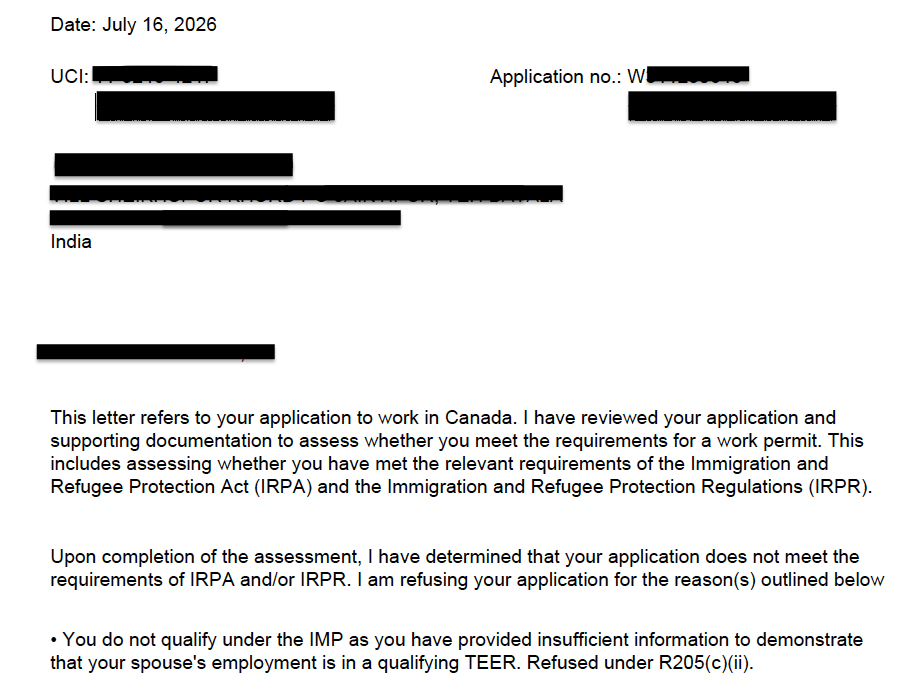
“You do not qualify under the IMP as you have provided insufficient information to demonstrate that your spouse’s employment is in a qualifying TEER.”
The spousal open work permit refusal was issued under R205(c)(ii).
The officer therefore concluded that the evidence submitted did not establish that the spouse’s employment met the required occupational criteria.
At first glance, this may appear to be a straightforward evidentiary refusal.
But when the officer’s decision notes are examined carefully, the reasoning becomes more specific.
What Did the Officer’s Decision Notes Say?
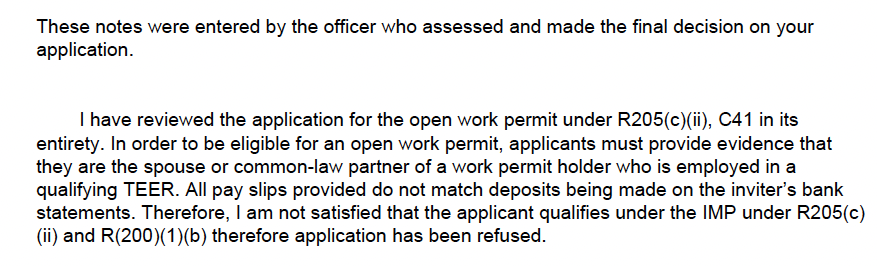
The officer’s notes state:
“I have reviewed the application for the open work permit under R205(c)(ii), C41 in its entirety.”
The notes then explain that applicants must provide evidence that they are the spouse or common-law partner of a work permit holder who is employed in a qualifying TEER.
The critical portion of the notes states:
“All pay slips provided do not match deposits being made on the inviter’s bank statements.”
The officer then concluded:
“Therefore, I am not satisfied that the applicant qualifies under the IMP under R205(c)(ii) and R200(1)(b) therefore application has been refused.”
In other words, the mismatch between the payroll documents and bank deposits became an important part of the officer’s assessment of whether the employment evidence was reliable enough to establish eligibility.
That is where the central issue in this case arises.
How Large Were the Alleged Discrepancies?
The discrepancies were examined carefully.
The figures were:
| Deposit date | Amount reflected in bank statement | Actual paycheque amount | Difference |
|---|---|---|---|
| January 13, 2026 | $782.00 | $782.88 | $0.88 |
| February 27, 2026 | $834.00 | $834.89 | $0.89 |
| March 16, 2026 | $924.00 | $924.84 | $0.84 |
The total difference across all three transactions was only $2.61.
More importantly, the difference was not a situation where a $900 paycheque was deposited as $500 or where an unexplained deposit appeared in the account.
The documents showed deposits that were extremely close to the corresponding payroll amounts.
The discrepancy was less than one dollar in each instance.
The Bank Subsequently Confirmed What Happened
Following the refusal, the applicant contacted CIBC to obtain clarification.
On August 5, 2026, CIBC responded to the applicant’s complaint and reviewed the transactions.
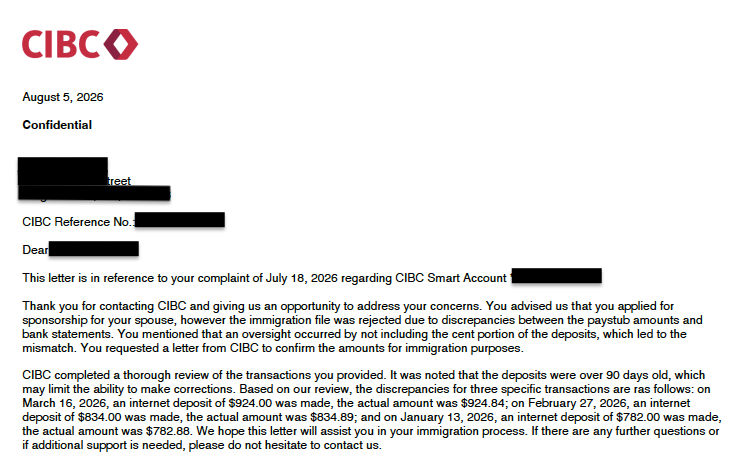
CIBC confirmed the following:
- March 16, 2026: the internet deposit showed $924.00, while the actual amount was $924.84.
- February 27, 2026: the internet deposit showed $834.00, while the actual amount was $834.89.
- January 13, 2026: the internet deposit showed $782.00, while the actual amount was $782.88.
CIBC also explained that the discrepancy arose because the cents portion of the deposits had not been included.
This is significant because it provides an independent explanation for why the numbers did not exactly match.
The bank itself reviewed the transactions and confirmed the actual amounts.
The Difference Was Less Than One Dollar Per Transaction
Put simply:
$782.88 → $782.00
Difference: $0.88
$834.89 → $834.00
Difference: $0.89
$924.84 → $924.00
Difference: $0.84
These were not unexplained deposits of hundreds of dollars.
They were not large discrepancies.
They were not multiple conflicting employers.
They were not completely different payroll amounts.
They were three deposits where the dollar amount corresponded closely with the paycheque, but the cents were not reflected in the bank statement.
The question therefore becomes:
Can such discrepancies reasonably support a conclusion that the employment evidence is insufficient to establish eligibility under C41?
That is one of the issues being raised in the Federal Court proceeding.
Why the CIBC Letter Matters.
The CIBC letter is particularly important because it was obtained after the refusal and directly addresses the alleged discrepancy.
It provides documentary confirmation from the financial institution concerning the transactions.
The letter states that CIBC reviewed the transactions and identified the actual amounts.
This gives context to what the officer saw in the original application.
However, there is an important distinction in judicial review proceedings.
The Federal Court generally reviews the legality and reasonableness of the decision based on the record that was before the decision-maker, subject to the applicable legal principles and recognized exceptions.
Therefore, the CIBC letter does not simply become a new piece of evidence that the Federal Court can use to make the work permit decision itself.
Instead, its significance may include helping explain what the apparent discrepancies actually represented and supporting the argument that the underlying concern was capable of being clarified.
The precise evidentiary role of the letter would depend on the legal arguments advanced in the judicial review.
The Procedural Fairness Issue
There is another important aspect of this case.
The officer’s notes identify a concern about the relationship between the pay slips and the bank deposits.
But the applicant was not given a Procedural Fairness Letter (PFL) asking them to explain the discrepancy before the refusal.
This raises a procedural fairness question.
Procedural fairness is context-specific. The Supreme Court of Canada has emphasized that the content of procedural fairness depends on the circumstances of the particular decision, including the nature of the decision, the statutory scheme, the importance of the decision to the affected person, and other factors.
The Supreme Court has also emphasized the importance of giving affected individuals an opportunity to present their case fully and fairly where the duty of procedural fairness requires it.
That does not mean that every discrepancy in an immigration application automatically requires a procedural fairness letter.
Nor does every immigration officer have to ask an applicant about every inconsistency before making a decision.
The legal question is more specific:
In the circumstances of this particular application, did the officer have a duty to give the applicant an opportunity to address the concern before relying on it to refuse the application?
That is an issue for the Court to determine based on the complete record and applicable law.
Why the Opportunity to Explain Could Have Mattered
Consider what happened here.
The officer saw:
Paycheque: $782.88
Bank statement: $782.00
Rather than being given an opportunity to explain the discrepancy, the application was refused.
Had the applicant been asked about the difference, the applicant could have explained that the discrepancy related to the cents portion of the deposit.
The applicant could also have obtained confirmation from CIBC.
And that is precisely what subsequently occurred.
The bank reviewed the transactions and confirmed the amounts.
This creates an important question about the decision-making process:
If the officer’s concern could have been readily explained by the applicant, should the applicant have been given an opportunity to provide that explanation before the concern became determinative?
Again, this is not a statement that a PFL was legally mandatory in every such case.
It is the procedural fairness issue being raised in this particular matter.
Reasonableness Is Also a Separate Issue
Procedural fairness is only one part of the case.
The second major issue is reasonableness.
The Supreme Court of Canada explained in Canada (Minister of Citizenship and Immigration) v. Vavilov that reasonableness review examines whether a decision is justified, transparent and intelligible in light of the relevant legal and factual constraints.
The Court does not simply substitute its preferred answer for the immigration officer’s answer.
Instead, the Court reviews the decision-making process and reasons within the applicable standard of review.
That distinction is extremely important in immigration judicial review.
The Question Is Not Simply: “Was There a Discrepancy?”
There was a discrepancy.
The question is what legal significance the officer reasonably could attach to it.
An immigration officer is entitled to assess the evidence submitted by an applicant.
An officer may identify inconsistencies.
An officer may determine that evidence is insufficient.
But the reasons must still logically support the conclusion reached.
In this case, the discrepancy was:
- $0.88;
- $0.89; and
- $0.84.
The bank subsequently confirmed that these differences related to the cents portion of the deposits.
The Federal Court will therefore have to consider the decision within the complete factual and legal context.
A Minor Error Does Not Automatically Establish Genuine Employment
It is also important to be precise about the legal argument.
The argument is not that any small discrepancy must automatically be ignored by an immigration officer.
Nor is the argument that an applicant can provide contradictory financial records without consequence.
Instead, the issue is whether the particular discrepancy in this case reasonably justified the conclusion drawn from it.
An officer is required to assess the evidence as a whole.
The relevant evidence can include:
- employment letters;
- job descriptions;
- NOC classification;
- pay slips;
- bank statements;
- employment contracts;
- tax documents;
- work permits;
- employer information;
- and other evidence establishing genuine employment.
IRCC’s current instructions themselves identify employer documentation showing employment details, occupation, duties and NOC/TEER information as relevant evidence for these work permit applications.
The question in this case is whether the tiny banking discrepancies were reasonably capable of undermining the broader evidence of employment.
The 16-Month Issue
There is another practical problem facing the client.
Under the current IRCC instructions for spouses of high-skilled workers under this measure, the principal worker’s work permit or authorization generally must be valid for at least 16 months after IRCC receives the spouse’s open work permit application, subject to specified exceptions.
In this case, the spouse’s Post-Graduation Work Permit does not provide the client with a straightforward opportunity to simply submit another C41 application once the relevant eligibility window has passed.
That makes the refusal particularly consequential.
The issue is therefore not simply:
“The application was refused. Submit another application.”
The availability and viability of another application depend on the applicant’s circumstances and the applicable rules at the time.
For this client, judicial review has become an important avenue to challenge the refusal.
Why Federal Court Judicial Review Is Different
A Federal Court judicial review is not an appeal in the traditional sense.
The Federal Court does not simply reconsider the application and decide whether it would have approved the work permit.
Instead, the Court reviews the decision-making process under the applicable administrative-law principles.
The Federal Court describes its jurisdiction as including judicial review of immigration decisions made under the Immigration and Refugee Protection Act, including decisions of immigration officers concerning temporary residence and other immigration matters.
If the Court grants judicial review, the usual remedy is that the matter is sent back for reconsideration by the decision-maker.
The Court does not ordinarily issue the work permit itself.
The Federal Court’s own guidance explains that, where judicial review is granted, the Court may refer the matter back to the decision-maker for reconsideration.
What Are We Asking the Federal Court to Examine?
The case raises several questions.
1. Was the officer’s treatment of the banking discrepancy reasonable?
The officer relied on the mismatch between pay slips and bank deposits.
The Court can examine whether the reasoning connecting that evidence to the conclusion was justified in the circumstances.
2. Did the officer adequately consider the evidence as a whole?
The application contained employment evidence.
The issue is whether the officer’s reasons adequately explain why the discrepancy was sufficient to conclude that the applicant had not demonstrated qualifying employment.
3. Did the officer’s concern engage procedural fairness?
If the officer had a significant concern about the genuineness or reliability of the employment evidence, was the applicant entitled, in the circumstances of this case, to an opportunity to address that concern?
4. Were the reasons sufficiently transparent and intelligible?
The Supreme Court’s Vavilov framework emphasizes that reasons must meaningfully justify the decision in light of the evidence and legal constraints applicable to the decision.
These are the types of legal questions that judicial review can address.
The Importance of the Officer’s Actual Reasons
One of the most important documents in a Federal Court immigration case is the Global Case Management System (GCMS) notes, also known as officer decision notes.
The refusal letter may provide only a brief explanation.
The officer’s notes can provide much more information about:
- what evidence was reviewed;
- what concerns the officer had;
- what findings were made;
- how the evidence was interpreted;
- and why the application was ultimately refused.
Here, the notes identify the pay slip/bank deposit mismatch as a central concern.
That makes the exact reasoning particularly important.
The judicial review is therefore not simply about disagreeing with the outcome.
It is about examining how the decision was reached.
Why the CIBC Confirmation Strengthens the Factual Context
The CIBC letter dated August 5, 2026 provides a particularly useful factual clarification.
The bank independently reviewed the transactions and confirmed that:
| Date | Bank-recorded deposit | Actual amount | Difference |
|---|---|---|---|
| January 13, 2026 | $782.00 | $782.88 | $0.88 |
| February 27, 2026 | $834.00 | $834.89 | $0.89 |
| March 16, 2026 | $924.00 | $924.84 | $0.84 |
This means that the apparent mismatch was not evidence of three dramatically different transactions.
The amounts were remarkably close.
The bank’s explanation provides a factual explanation for the missing cents.
That distinction matters.
Could the Officer Have Asked for an Explanation?
This is perhaps the most important question raised by this case.
Suppose the officer had sent a PFL stating:
“The pay slips indicate payments of $782.88, $834.89 and $924.84, but the bank statements show deposits of $782.00, $834.00 and $924.00. Please explain these discrepancies and provide supporting evidence.”
The applicant could have responded.
The applicant could have contacted CIBC.
CIBC could have confirmed the transactions.
The discrepancy could then have been assessed with the additional explanation.
Instead, according to the documents provided, the application was refused without that opportunity.
Whether that breached procedural fairness is ultimately a legal question for the Federal Court.
Immigration Officers Are Allowed to Scrutinize Evidence
It is important not to misunderstand the argument.
Canadian immigration officers have an important responsibility to assess whether applicants meet the requirements of the Immigration and Refugee Protection Act and Regulations.
IRCC expressly requires applicants to provide evidence supporting their eligibility.
Officers can identify inconsistencies and determine that evidence is insufficient.
The argument in this case is narrower:
When an inconsistency is extremely small, readily explainable, and potentially determinative of the application, did the particular circumstances require the applicant to be given an opportunity to address the concern?
And separately:
Did the officer’s conclusion logically follow from the evidence that was before the officer?
Those are the questions being placed before the Court.
Federal Court Judicial Review Is About Legal Errors
A refusal does not automatically mean that an immigration officer made a legal error.
Likewise, an applicant being disappointed with an immigration decision is not enough to obtain judicial review.
There needs to be a reviewable basis.
Depending on the facts, potential grounds can include:
- unreasonable decision-making;
- failure to consider relevant evidence;
- misunderstanding material evidence;
- internally inconsistent reasoning;
- inadequate justification;
- procedural unfairness;
- failure to provide an opportunity to respond where procedural fairness required one; or
- an error in interpreting or applying the applicable legal framework.
The exact grounds depend on the decision and the administrative record.
What Happens After a Federal Court Judicial Review Application?
An immigration judicial review begins with an Application for Leave and for Judicial Review.
The Federal Court’s current guidance states that an immigration judicial review generally must be filed within:
- 15 days for a matter arising in Canada; or
- 60 days for a matter arising outside Canada,
calculated from when the applicant is notified of or becomes aware of the matter being challenged.
This is why anyone considering judicial review should obtain legal advice promptly after receiving a refusal.
The process involves an initial leave stage.
If leave is granted, the judicial review proceeds to a hearing.
The Court’s current guidance describes the process and confirms that, if judicial review is allowed, the matter may be sent back to the decision-maker for reconsideration.
This Case Is About More Than 84 Cents
At first glance, someone might look at this case and say:
“Why would someone go to Federal Court over 84 cents?”
But that misses the legal issue.
The case is not really about 84 cents.
It is about what conclusions an immigration decision-maker can reasonably draw from evidence and what procedural safeguards may apply when a concern becomes determinative of an application.
The difference between $924.84 and $924.00 may be financially insignificant.
But if that difference becomes the basis for questioning the genuineness of employment and refusing a spouse’s work permit, its immigration consequences can be enormous.
That is why the legal analysis matters.
Families Can Face Significant Consequences From Temporary Residence Refusals
A spousal open work permit can have substantial practical consequences for a family.
A refusal can affect:
- the ability of spouses to work in Canada;
- family finances;
- career opportunities;
- immigration plans;
- the ability to live together;
- and future immigration options.
The Supreme Court in Vavilov recognized that the impact of an administrative decision on an individual can be relevant to the procedural protections owed and to the adequacy of justification required in the circumstances.
That does not mean every significant immigration decision must be approved.
It means the legal framework recognizes that the consequences of administrative decisions can matter when assessing the decision-making process.
Our Position in This Case
Our position is that the three discrepancies were minor, readily explainable and not, on their own, a rational basis for rejecting the evidence of genuine qualifying employment.
The CIBC letter provides an explanation for the discrepancies.
We also take the position that the applicant should have been given an opportunity to respond if the officer’s concerns about the discrepancies were sufficiently serious and determinative to require a response under the circumstances.
The Federal Court will ultimately decide whether the decision meets the applicable legal standards.
The Goal of the Federal Court Application
The objective is not to ask the Federal Court to simply issue the client a work permit.
The objective is to have the Court determine whether the refusal was legally sustainable.
If the Court finds a reviewable error and grants judicial review, the matter can generally be returned to the decision-maker for reconsideration.
That reconsideration would then have to occur in accordance with the Court’s judgment and the applicable law.
What Applicants Should Learn From This Case
There are several practical lessons.
1. Keep employment records consistent
When applying for a spousal open work permit, make sure that:
- employment letters;
- pay slips;
- bank statements;
- contracts;
- tax records;
- and other employment documents
are accurate and consistent wherever possible.
2. Explain discrepancies proactively
If there is a legitimate reason why a pay slip does not exactly correspond to a bank deposit, explain it.
Do not assume that an officer will automatically understand the reason.
3. Obtain supporting documentation
If a bank transaction is unusual or difficult to understand, obtaining confirmation from the bank can be extremely useful.
4. Read the refusal carefully
The refusal letter may not tell the whole story.
The officer’s notes can reveal the actual reasoning behind the decision.
5. Act quickly after a refusal
Judicial review has strict timelines. The Federal Court currently identifies a 15-day or 60-day filing period depending on whether the immigration matter arises in Canada or outside Canada.
6. Understand the difference between reapplying and judicial review
A new application and a judicial review serve different purposes.
A new application attempts to establish eligibility again.
A judicial review challenges the legality or reasonableness of the existing decision.
Which option is appropriate depends on the individual circumstances.
Conclusion: When a Small Discrepancy Leads to a Major Immigration Consequence
This case illustrates why immigration refusals should sometimes be examined beyond the first page of the refusal letter.
The three discrepancies identified by the officer were:
$0.88 $0.89 $0.84
CIBC subsequently reviewed the transactions and confirmed the actual amounts and the explanation for the difference.
Yet those discrepancies formed part of the basis for the officer’s conclusion that the applicant had not provided sufficient information to demonstrate that the spouse’s employment was in a qualifying TEER.
The case therefore raises two central legal questions:
Was the officer’s conclusion reasonable in light of the evidence?
and
Should the applicant have been given an opportunity to address the officer’s concern before the application was refused?
Those are precisely the types of issues that can be examined through Federal Court judicial review.
The Federal Court provides judicial oversight of immigration decisions, but it does not simply substitute its own decision for that of the immigration officer. The Court applies the applicable principles of judicial review to determine whether the decision was legally sustainable.
For our client, the Federal Court is now the avenue through which these issues will be tested.
Have You Received an IRCC Refusal?
If your Canadian immigration application has been refused and you believe the officer:
- misunderstood important evidence;
- failed to consider relevant evidence;
- relied on a minor discrepancy in a way that affected the outcome;
- reached a conclusion that may not be adequately supported by the record;
- or failed to provide procedural fairness where required,
you should obtain legal advice promptly.
Fateh Law Corporation focuses on Canadian immigration litigation, including Federal Court judicial reviews and Immigration Appeal Division matters.
Contact Fateh Law Corporation
Canada: +1 604 259 6078
India: +91 9875950786
Website: navratanfateh.com
Fateh Law Corporation
Canadian Immigration Litigation | Federal Court | Immigration Appeal Division
This article is for general educational purposes only. The outcome of any Federal Court judicial review depends on the specific facts, evidence, administrative record and applicable law. Past results or challenges do not guarantee a particular outcome in another case.