


Every year, thousands of international students invest significant time, money, and effort to pursue higher education in Canada. They leave behind their families, adapt to a new culture, complete demanding academic programs, and contribute to Canada’s economy and communities.
For many of these students, graduation is not the end of their journey—it is the beginning of their professional careers in Canada. The Post-Graduation Work Permit (PGWP) is often the bridge between education and permanent residence. Without it, years of planning and investment can be jeopardized.
Unfortunately, not every PGWP application is decided fairly.
At Fateh Law Corporation, we have seen numerous cases where deserving applicants received refusals because of administrative errors, misunderstandings, or legal mistakes. While every refusal is unique, one issue became particularly common after IRCC introduced new language proficiency requirements for certain PGWP applicants.
Many students had successfully completed approved English language tests. They possessed valid language results and met the legal requirements. Yet their applications were refused because the online application system did not clearly provide a place for applicants to upload those results. As a result, many applicants unknowingly submitted incomplete applications despite having all the required documents.
This blog discusses one such case and explains how the Federal Court process ultimately helped our client obtain the work permit she deserved.
It also highlights an important legal lesson:
Missing a limitation period does not always mean your case is over.
In appropriate circumstances, the Federal Court has the discretion to extend the time for commencing a judicial review. Understanding when and how to seek that relief can make the difference between losing an opportunity forever and obtaining a successful outcome.
Understanding the Post-Graduation Work Permit
The Post-Graduation Work Permit is one of Canada’s most valuable immigration programs for international students.
Unlike employer-specific work permits, a PGWP generally allows graduates to work for almost any employer across Canada. Depending on the length of the completed educational program, the permit may be issued for up to three years.
The PGWP also provides valuable Canadian work experience, which may later support applications for permanent residence through various immigration pathways.
For many graduates, the PGWP is not simply another immigration document—it represents years of educational investment and future career opportunities.
Because of its importance, a refusal can have devastating consequences.
A refused applicant may lose:
- The opportunity to work legally in Canada.
- Valuable Canadian work experience.
- Eligibility for future immigration programs.
- Employment opportunities.
- Income needed to support themselves.
- Long-term immigration plans.
This is why every work permit refusal deserves careful legal analysis.
A New Requirement Created New Problems
IRCC introduced language proficiency requirements for many PGWP applicants.
From a policy perspective, requiring applicants to demonstrate language ability may appear straightforward.
However, practical implementation presented unexpected challenges.
Many applicants completed approved language examinations before submitting their applications.
They had valid language scores.
They met the legal requirement.
The problem was not the applicants.
The problem was the application process itself.
Many applicants discovered that the online portal did not clearly direct them to upload their language test results or provide an obvious location for those documents.
As a result, numerous students assumed that no additional upload was required.
Only later did they receive refusal letters stating that they had failed to provide proof of language proficiency.
For many students, this came as a complete surprise.
They had complied with the law.
They possessed the required documentation.
Yet they lost their applications because of how the electronic application process functioned.
Our Client’s Story Begins
Our client was an international student who had successfully completed her studies in Canada.
Like thousands of graduates every year, she planned to remain in Canada by obtaining a Post-Graduation Work Permit.
She prepared her application in good faith.
She had completed an approved language examination.
She possessed valid language test results.
She believed she had satisfied every legal requirement.
Unfortunately, when her application was submitted, the language test results were not uploaded.
This was not because she lacked the required scores.
Nor was it because she intended to withhold information.
Instead, the application was submitted without those documents because the online process did not clearly prompt for their upload.
Months later, IRCC refused her application.
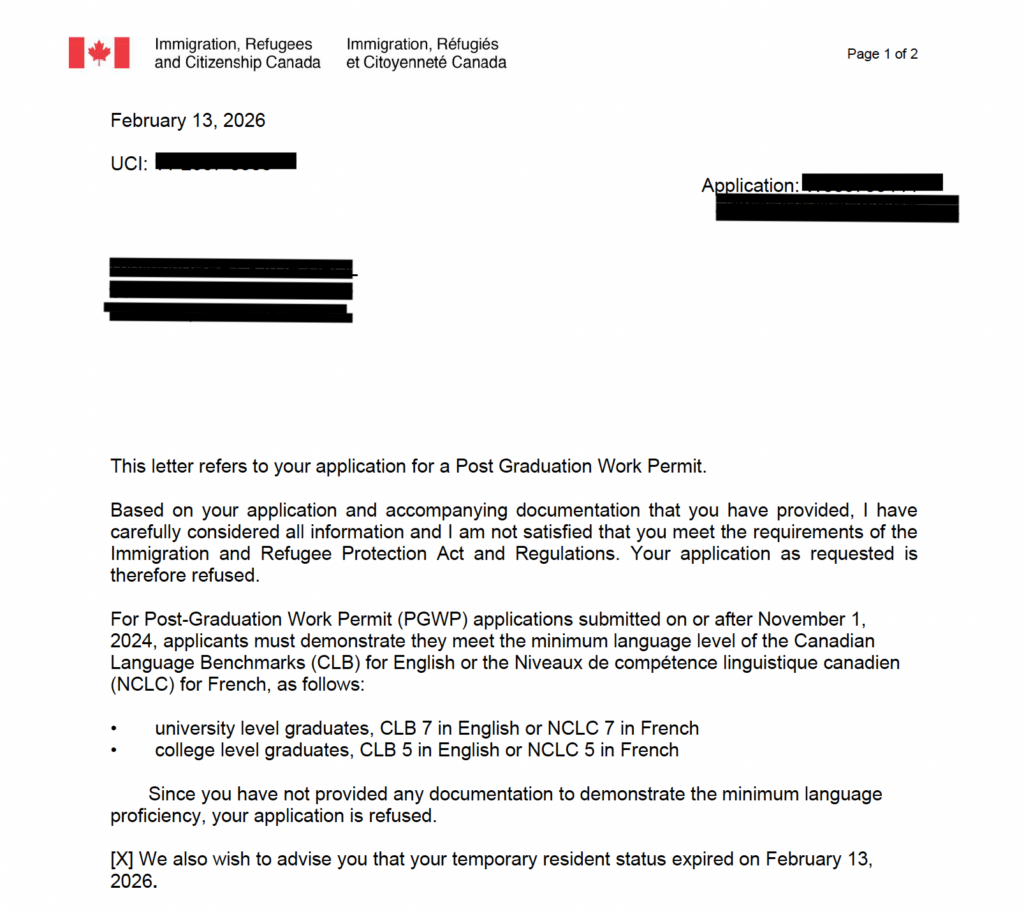
The refusal stated that she had failed to provide proof of language proficiency.
Like many international students facing a refusal for the first time, she did not immediately understand the legal options available to challenge the decision.
She assumed the refusal could simply be corrected by providing the missing document.
Unfortunately, immigration law is rarely that simple.
The First Critical Decision
Following the refusal, our client sought professional assistance.
She was advised not to challenge the refusal before the Federal Court.
Instead, she was advised to submit a restoration application together with her language test results.
At first glance, this advice appeared logical.
After all, if the only missing document was the language score, why not simply provide it?
Many applicants understandably believe that once the missing document is supplied, IRCC will correct its earlier decision.
Sometimes that happens.
Many times, it does not.
A reconsideration request or restoration application is not a substitute for judicial review.
IRCC has complete discretion over whether it wishes to reconsider a previous decision.
There is generally no legal obligation requiring an officer to reopen a refused application merely because additional documents are later submitted.
That distinction is one of the most misunderstood aspects of Canadian immigration law.
Applicants often believe that once they explain the situation through a webform, a reconsideration request, or additional correspondence, IRCC must revisit the refusal.
In reality, the refusal often remains unchanged.
Meanwhile, the statutory limitation period for commencing judicial review continues to run.
By the time many applicants realize that reconsideration has failed, the deadline to commence Federal Court proceedings may already have expired.
Unfortunately, this is precisely where many strong cases are lost.
When One Problem Was Solved, Another Appeared
The restoration application included the very document that had been missing from the original application—the language test results.
The original concern appeared to have been addressed.
However, immigration matters often involve multiple legal requirements.
Solving one issue does not necessarily resolve every problem.
A second issue soon emerged.
Because significant time had passed after the original refusal, IRCC determined that the client had applied beyond the period permitted for obtaining a Post-Graduation Work Permit following completion of her studies.
The application was refused again.
Our client now faced two separate refusals, each involving different legal issues.
At this stage, she was again encouraged to pursue reconsideration rather than Federal Court litigation.
Fortunately, before it was too late, she sought legal advice regarding judicial review.
That decision changed the direction of her case completely.
Before continuing, this section explains the legal strategy used in this case. As with Part 1, certain facts have been generalized to protect client confidentiality.
Challenging Both Refusals in the Federal Court – How Judicial Review Changed the Outcome
A Fresh Legal Assessment
When our client retained Fateh Law Corporation, we approached the matter differently.
Rather than asking whether IRCC might reconsider its decision, we asked a more important question:
Were the refusals legally reasonable?
That distinction is critical.
A reconsideration request asks IRCC to voluntarily revisit its own decision. Judicial review asks the Federal Court to determine whether the decision was lawful, procedurally fair, and reasonable under Canadian administrative law.
These are two very different processes.
Our review revealed that the case involved two separate refusals, each raising different legal issues.
- The first refusal was based on the alleged failure to provide proof of language proficiency.
- The second refusal arose after a restoration application was submitted with the language results attached, but IRCC determined that the application had been made outside the permitted PGWP eligibility period following the completion of studies.
At first glance, the situation appeared extremely difficult.
The limitation period for challenging the first refusal had already expired.
The second refusal, however, was still within the time limit to commence an application for judicial review.
Many people would have concluded that only the second refusal could be challenged.
We did not.
Understanding the Limitation Period
One of the biggest misconceptions in Canadian immigration law is that once the deadline to file an application for judicial review has passed, the case is automatically over.
That is not always true.
Under the appropriate circumstances, the Federal Court has discretion to grant an extension of time.
An extension is not automatic. An applicant must provide persuasive reasons explaining why the deadline was missed and why it is in the interests of justice for the Court to hear the matter despite the delay.
Every case depends on its own facts.
The Court may consider factors such as:
- the length of the delay;
- the explanation for the delay;
- whether the applicant acted diligently once aware of the issue;
- whether there is an arguable case;
- whether granting an extension would unfairly prejudice the other party; and
- the overall interests of justice.
Many applicants mistakenly assume that an expired limitation period leaves them with no legal options. As a result, they abandon potentially meritorious cases without ever consulting a lawyer experienced in Federal Court litigation.
Our client’s case illustrates why that assumption can be costly.
Looking Beyond the Deadline
When we reviewed the file, we considered the entire sequence of events rather than focusing only on the calendar.
Our client had not ignored the refusal.
She had attempted to resolve the issue through the immigration processes that had been recommended to her.
She had acted in good faith and continued pursuing a solution rather than abandoning her application.
The fact that she had first followed advice to pursue restoration and reconsideration did not necessarily mean she should forever lose the opportunity to seek judicial review.
That became an important aspect of our legal strategy.
We prepared arguments explaining why the Court should exercise its discretion to permit the challenge to proceed despite the expired limitation period relating to the original refusal.
At the same time, we commenced proceedings regarding the second refusal within the applicable limitation period.
Rather than viewing the two refusals in isolation, we presented the broader factual context and explained how each decision was connected to the other.
Why the Original Refusal Still Mattered
Some may ask why we devoted significant attention to the first refusal when a second refusal already existed.
The answer is straightforward.
The second refusal was built upon what had happened after the first.
If the original refusal had not occurred, the subsequent restoration application—and the timing issues that followed—may never have arisen.
The original refusal was therefore central to understanding the overall fairness of the case.
We believed that addressing only the second refusal would not fully resolve the underlying problem.
Accordingly, our legal strategy sought to place both decisions before the Court and before the Department of Justice so that the entire history could be evaluated.
Engaging the Department of Justice
Once an application for judicial review is commenced, the matter enters a different legal process.
Instead of corresponding only with IRCC, counsel for the applicant communicates with lawyers representing the Department of Justice, who act on behalf of the Minister in Federal Court proceedings.
This changes the dynamic.
Government litigation counsel can assess the strengths and weaknesses of the case, obtain instructions from IRCC, and consider whether a negotiated resolution is appropriate.
Not every case settles.
However, where a legal error may have occurred or where continued litigation is not in anyone’s interests, settlement discussions can sometimes provide an efficient resolution.
In our client’s case, we presented detailed legal arguments explaining why the circumstances justified relief.
We emphasized that our client had, in fact, completed the required language testing and that the matter should be assessed in light of the full factual history, including the steps she had taken after the initial refusal.
Settlement Discussions
Federal Court litigation is often misunderstood.
Many people assume that every case proceeds all the way to a hearing before a judge.
In reality, a significant number of immigration judicial review applications resolve before a hearing through discussions between counsel.
That is one reason why commencing a judicial review can be so important.
Once litigation begins, the government has an opportunity to reassess the file through experienced litigation counsel.
In this case, discussions took place between our office and the Department of Justice.
The Department of Justice, after consulting with its client, IRCC, agreed that the matter should be reconsidered.
Rather than continuing to defend the litigation, the government chose to resolve the case by allowing the original refusal to be reconsidered.
This was a significant development.
It meant that the focus returned to the original application rather than leaving our client permanently disadvantaged by the procedural complications that had followed.
The Result
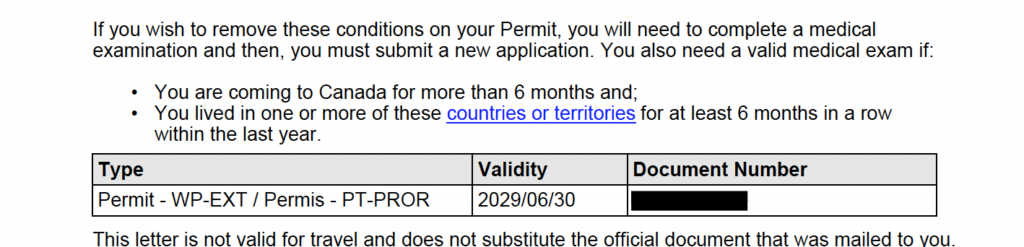
Following the reconsideration of the original refusal, our client ultimately received her Post-Graduation Work Permit.
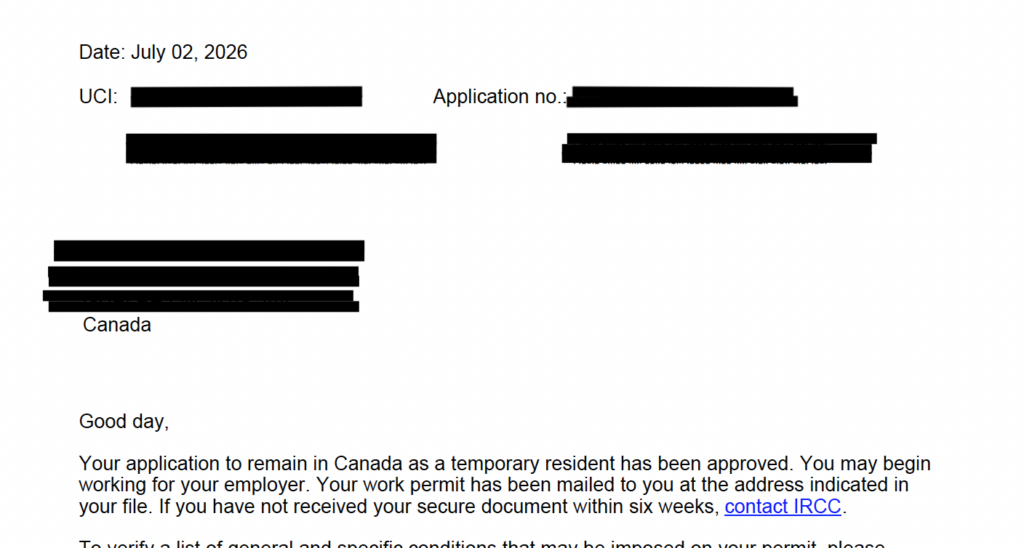
For her, the outcome represented much more than an immigration document.
It meant the ability to work legally in Canada, continue building Canadian work experience, and pursue her long-term immigration goals.
It also reinforced an important lesson:
A refusal is not always the end of the story.
The legal options available depend on the facts, the applicable law, and the procedural history of the case. An early legal assessment can identify opportunities that may otherwise be overlooked.
Important Lessons for International Students
Our client’s experience highlights several practical lessons for anyone facing a PGWP refusal.
First, read every refusal letter carefully. The reasons provided by IRCC will determine the legal issues that must be addressed.
Second, understand the difference between a reconsideration request and judicial review. A reconsideration request asks IRCC to voluntarily reopen a file, while judicial review invokes the supervisory jurisdiction of the Federal Court. They are not interchangeable remedies.
Third, do not assume that an expired limitation period automatically ends your legal options. Depending on the circumstances, it may still be possible to ask the Court for an extension of time. Whether such a request should be made requires a careful legal assessment.
Fourth, seek advice promptly. Delay can limit available remedies and make an already difficult case even more challenging.
Finally, obtain advice from a lawyer experienced in Federal Court litigation. The strategy that is appropriate for one case may not be appropriate for another, and timely legal guidance can be decisive.