

At Fateh Law Corporation, we often meet clients when their immigration journey has reached a critical turning point. One such case—argued on December 11 before the Federal Court of Canada—highlights why legal strategy, deadlines, and experienced representation can make the difference between losing and protecting your future in Canada.
This case is not just about one applicant. It is a warning—and a lesson—for anyone who has received an immigration refusal inside Canada.
The Background: A Consultant’s Silence and a Missed Opportunity
Our client had applied for permanent residence under the Canadian Experience Class (CEC) through a consultant. Unfortunately, when her application was refused in October 2023, she was not advised of a critical legal fact:
👉 She had only 15 days to challenge the refusal in the Federal Court of Canada.
Instead of explaining this deadline, the consultant filed a reconsideration request. That reconsideration was eventually refused in April 2024.
By the time the client approached Fateh Law Corporation in April 2024, the limitation period to challenge the original refusal had already expired. Legally, we could now only challenge the reconsideration refusal, not the original decision itself.
This single oversight dramatically narrowed the legal options available to her.
Why Was the CEC Application Refused?
The refusal itself raised serious legal concerns.
Our client had gained qualifying Canadian work experience between November 2020 and November 2021, during the peak of the COVID-19 pandemic—a period marked by layoffs, hiring freezes, and limited opportunities.
Key facts accepted by the officer:
- ✔️ Her job duties were genuine
- ✔️ Her supervisory role was real
- ✔️ Her employment period was verified
- ✔️ She fully responded to a Procedural Fairness Letter
The officer accepted every explanation—except one.
The officer focused solely on her hourly wage of $15, which was below the median wage of approximately $32/hour, and concluded that her work experience was not genuine.
What the Law Actually Says About Wages
This is where the refusal became legally vulnerable.
Both the Federal Court of Canada and the Federal Court of Appeal have consistently held that:
Wage alone cannot be a determining or gatekeeping factor when assessing the genuineness of work experience.
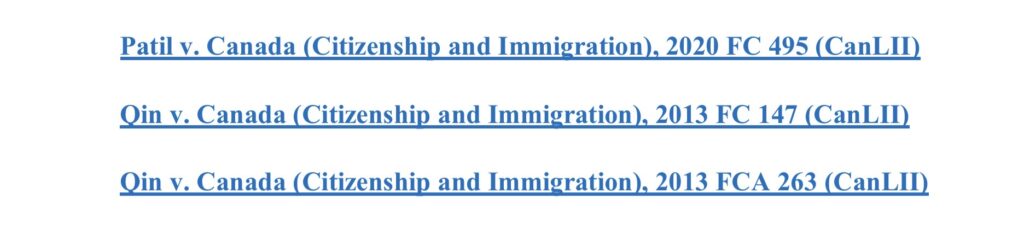 While wage may be a starting point for analysis, an immigration officer cannot rely on salary alone to refuse an application—especially when:
- Duties are genuine
- Employment is documented
- Context (such as COVID-era job markets) explains lower wages
In our client’s case, she accepted a lower wage due to limited opportunities and lack of prior experience during COVID, a reality faced by thousands of workers at the time.
The Legal Challenge: Strong Law, Procedural Limitations
When Fateh Law Corporation argued this case on December 11, the legal principles were strongly in our favor.
However, we were candid with the Court about the only weakness in the case:
- The original refusal deadline had been missed
- We were limited to challenging the reconsideration refusal
Despite this, we advanced robust legal arguments showing that the officer’s reasoning was unreasonable and contrary to established Federal Court jurisprudence.
The Federal Court judge has reserved the decision, and we remain hopeful that justice will be delivered.
The Most Important Lesson: Never Miss the 15-Day Deadline
This case carries a powerful warning:
If your refusal is issued inside Canada, you have ONLY 15 DAYS to file for judicial review in the Federal Court of Canada.
- A reconsideration request is optional
- A judicial review deadline is mandatory
- IRCC is not obligated to respond to or approve reconsiderations
- Missing the Federal Court deadline can permanently close the door on your strongest remedy
Best Practice:
✔️ Always file for judicial review as a backup, even if you are pursuing reconsideration
✔️ Protect your rights first—strategy can be adjusted later
Why Hiring a Law Firm Matters
Not all representatives can represent you in the Federal Court.
Only a Canadian barrister and solicitor can:
- Assess refusals through a litigation lens
- Preserve limitation periods
- Build arguments aligned with Federal Court jurisprudence
- Challenge unreasonable and unjust decisions effectively
At Fateh Law Corporation, Federal Court litigation is not an afterthought—it is a core part of our immigration strategy.
Facing a Refusal? Act Before Time Runs Out
If your immigration application has been:
- Refused on unreasonable grounds
- Denied based on incomplete or incorrect legal reasoning
- Mishandled by a consultant or prior representative
⏳ Time is not on your side—but the law may be.
📞 Contact Fateh Law Corporation today to assess whether your refusal can be challenged in the Federal Court of Canada.
Your permanent residence should not be lost because of a missed deadline or poor advice.