


Obtaining an LMIA-based work permit is already one of the most difficult pathways under Canadian immigration law. Employers must prove there is no Canadian citizen or permanent resident available for the job. The process is expensive, time-consuming, and heavily scrutinized.
Now imagine going through that entire process—successfully obtaining an LMIA—only to have your work permit refused based on wrong assumptions made by an immigration officer.
That is exactly what happened to our client, a self-employed electrician, whose genuine experience was dismissed due to a misunderstanding of how self-employed professionals are paid.
At Fateh Law Corporation, we fight these injustices every day.
The Problem: IRCC Misunderstood Self-Employment
Our client was self-employed. Like many independent contractors and tradespeople, he:
- Worked directly for multiple clients
- Issued invoices
- Received payments based on the nature and size of each job
- Did not receive “paystubs”
- Had a variable income depending on workload
This is normal in self-employment.
However, the immigration officer reviewing the file incorrectly assumed that our client should have had traditional paystubs. The officer then claimed:
“The paystubs do not match the bank statements.”
But here’s the problem:
❌ There were no paystubs
❌ The officer invented a standard that did not exist
❌ The officer ignored the business reality of self-employed workers
❌ The officer failed to analyze invoices and client payments properly
Instead of understanding how self-employment works, the officer imposed an employment model that simply did not apply.
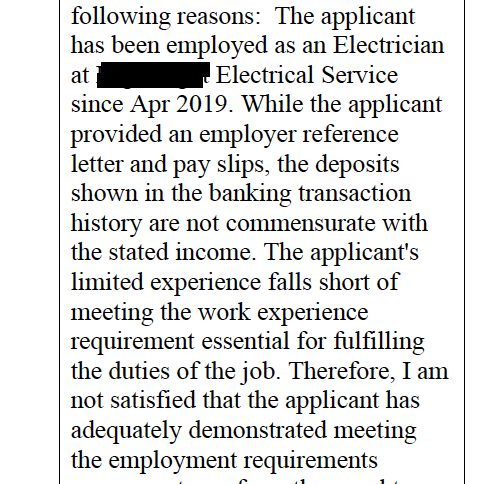
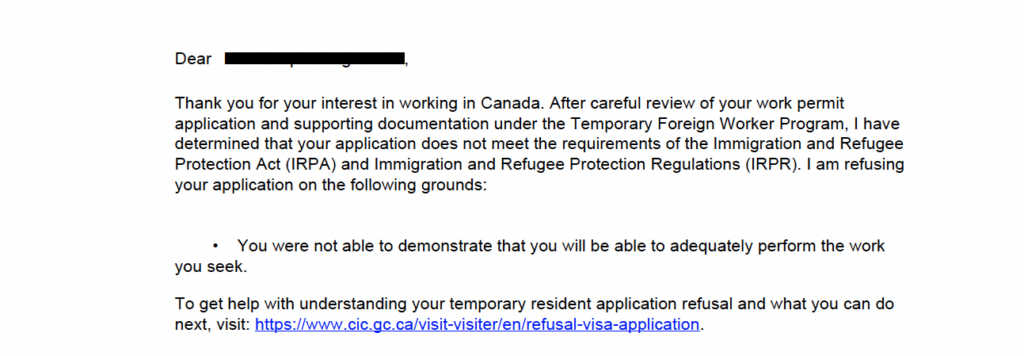
As a result, the officer concluded that our client’s work experience could not be verified—and refused the work permit.
This Was Not a Small Error—It Was a Legal Error
Canadian immigration decisions must be:
✔ Reasonable
✔ Evidence-based
✔ Logically explained
✔ Free from speculation
When officers make assumptions that are not supported by evidence, that is not just unfair—it is legally challengeable.
In this case, the officer:
- Assumed documents that did not exist
- Ignored real evidence
- Misapplied employment standards
- Failed to analyze the business model of a self-employed professional
This is exactly the type of mistake that the Federal Court of Canada exists to correct.
Why Most Applicants Lose at This Stage
Many applicants believe that if IRCC refuses them, that is the end of the road.
It is not.
But here’s the reality:
Most people do not know:
- That refusals can be challenged
- That there are strict deadlines
- That no new evidence can be added in the Federal Court
- That legal arguments matter more than emotional appeals
- That a properly argued case can lead to a settlement
This is where Fateh Law Corporation makes a difference.
How Fateh Law Corporation Fought This Case
We did not simply request reconsideration.
We filed a judicial review in the Federal Court of Canada.
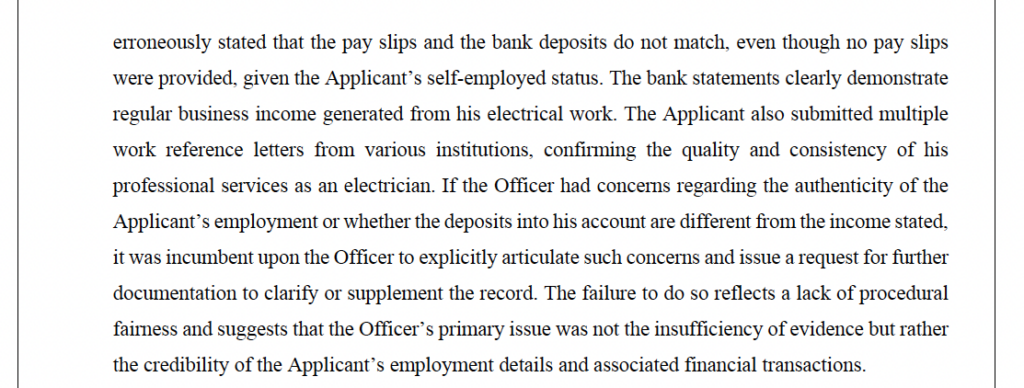
We prepared detailed legal submissions showing:
- The officer misunderstood self-employment
- The officer assumed the existence of paystubs
- The officer ignored invoice-based income structures
- The reasoning was illogical
- The decision was unreasonable under Canadian administrative law
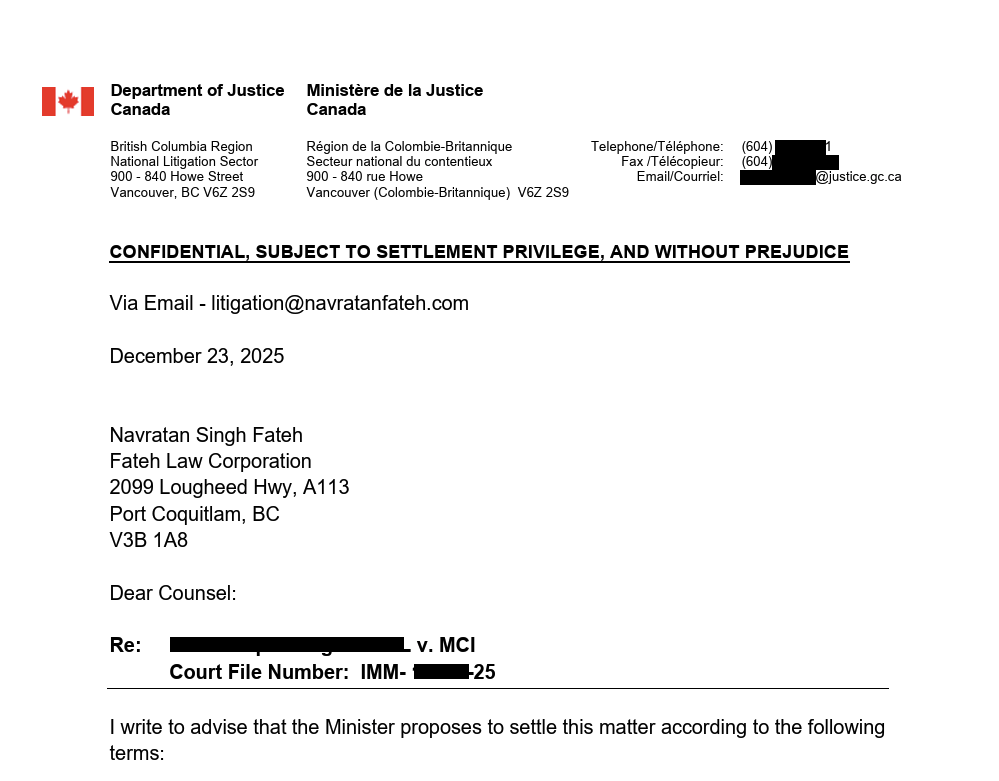
Once the Department of Justice reviewed our arguments, they recognized that the officer had made a serious mistake.
As a result:
✅ The case was settled
✅ The refusal will be set aside
✅ The file will be redetermined
✅ A new officer will review the application
This is not luck.
This is a litigation strategy.
Why a Settlement Matters
A Federal Court settlement means the government admits that the original decision cannot stand.
It gives your case a second life.
However, we are very clear with our clients:
⚠ A settlement is not an approval
⚠ It is a legal reset
⚠ The battle is only half won
Now, a new officer will re-evaluate the file properly, without the original mistakes.
We are hopeful—and we will continue fighting to ensure our client receives a fair and lawful outcome.
Self-Employed? You Are at a Higher Risk of Refusal
Self-employed workers face higher scrutiny because:
- Income is variable
- Documentation looks different
- Officers expect salaried models
- There is a misunderstanding of invoices
- There is a suspicion of credibility
This leads to wrongful work permit refusals—even when the experience is genuine.
If you are self-employed, you must prepare your case differently.
Why Clients Choose Fateh Law Corporation
RCIC consultants and agents are not permitted to appear in the Federal Court.
Only a Canadian Barrister & Solicitor can.
At Fateh Law Corporation, we:
✔ Litigate against IRCC
✔ File judicial reviews
✔ Handle settlements
✔ Argue procedural fairness
✔ Challenge unreasonable decisions
✔ Expose officer errors
✔ Force accountability
We do not just file applications.
We fight.
Refused? Don’t Reapply Blindly
Many people make this mistake:
They reapply with the same evidence, hoping for a different result.
That usually leads to:
❌ More refusals
❌ More suspicion
❌ Stronger negative history
❌ Harder future cases
If your refusal was based on:
- Wrong assumptions
- Ignored evidence
- Illogical reasoning
- Misunderstanding of your profession
- Credibility concerns
- Unfair conclusions
Then you may have a strong Federal Court case.
Time Limits Are Critical
If your refusal happened:
- Inside Canada → 15 days
- Outside Canada → 60 days
These deadlines are strict.
Once you miss them, your right to challenge is gone forever.
We Don’t Just Handle Files. We Defend People.
Behind every refusal is a human story.
Dreams. Careers. Families. Futures.
Our client is not a number. He is a professional who worked hard, built his business, and followed the law.
And when IRCC treated him unfairly, we stood up.
Facing a Similar Refusal?
If your work permit was refused because:
- Your self-employment was misunderstood
- Your income was misinterpreted
- Your experience was questioned
- Your documents were ignored
- The officer made assumptions
You do not have to accept it.
Contact Fateh Law Corporation
We specialize in:
- Federal Court litigation
- Judicial reviews
- Mandamus
- Unreasonable refusals
- Officer errors
- Procedural unfairness
- Delays
- LMIA-based refusals
We fight where others stop.
📩 Contact Fateh Law Corporation today.
⚖ Because justice should not depend on luck.