



How Fateh Law Corporation Challenged an Allegedly Unreasonable IRCC Refusal and the Client Received a Passport Request Less Than Two Months After Federal Court Proceedings Were Started
Disclaimer: This article is published for general educational and informational purposes only. It is not legal advice and should not be relied upon as legal advice for any individual immigration matter. Every immigration refusal and Federal Court proceeding is fact-specific. Anyone facing an IRCC refusal should obtain independent legal advice from a qualified Canadian immigration lawyer regarding their particular circumstances.
For many applicants, receiving one Canadian visitor visa refusal is discouraging. Receiving a second or third refusal can make it appear that approval may never come.
Our client had already experienced four previous refusals.
He nevertheless had a simple and deeply personal reason for wanting to travel to Canada: he wanted to visit his sister, a Canadian permanent resident, and spend time with her around Rakhi.
His fifth application was submitted on July 27, 2026.
On August 5, 2026, Immigration, Refugees and Citizenship Canada (IRCC) refused him again.
But this time, rather than simply filing a sixth visitor visa application and hoping for a different result, Fateh Law Corporation challenged the decision in the Federal Court of Canada.
The Federal Court proceeding was commenced on August 17, 2026.
Less than two months later, on October 6, 2026, the client received an Original Passport Request from IRCC.
After five refusals, the client could finally move forward with travelling to Canada to visit his sister.
This case illustrates an important lesson for applicants facing repeated Canadian immigration refusals:
Sometimes the issue is not that you need to submit the same application for a sixth or seventh time. The real question may be whether the latest refusal itself is legally unreasonable and should be challenged.
The Client’s Immigration History: Four Refusals Before Coming to Fateh Law Corporation
By the time this matter reached Fateh Law Corporation, the applicant was not dealing with his first Canadian visitor visa refusal.
He had already been refused four times.
Repeated refusals create a particularly difficult situation.
An applicant may respond to each refusal by submitting additional documentation, providing more financial information, and explaining the purpose of travel in greater detail. Nevertheless, the next application can still be refused.
That is why a person facing repeated refusals should consider obtaining legal advice about more than simply how to reapply.
A lawyer may also need to examine whether the refusal itself is reasonable and whether an Application for Leave and for Judicial Review before the Federal Court of Canada should be considered.
That was the approach taken in this case.
Fifth Visitor Visa Application Submitted — July 27, 2026
The client submitted the latest temporary resident visa application to IRCC on July 27, 2026.
The purpose of the proposed trip was a family visit.
According to the materials submitted with the application, the applicant intended to travel from approximately August 15 to August 30, 2026.
One of the significant purposes of the trip was to visit his sister in Canada around the occasion of Rakhi.
This was therefore not an abstract or unexplained trip. The application identified a specific family relationship, proposed travel period, and purpose.
The application also contained financial documentation.
According to the materials submitted by Fateh Law Corporation, the applicant disclosed approximately:
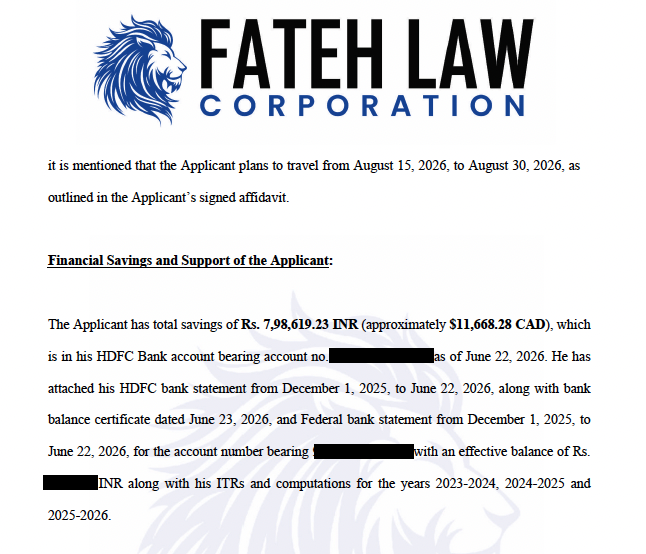
₹7,98,619.23 INR in savings — approximately CAD $11,668.28.
The application materials also referred to supporting financial records, including bank statements, a bank balance certificate, additional banking information and income-tax documentation.
Despite these materials, the application was refused.
Fifth Refusal — August 5, 2026
Only days after the application was submitted, IRCC issued its decision on August 5, 2026.
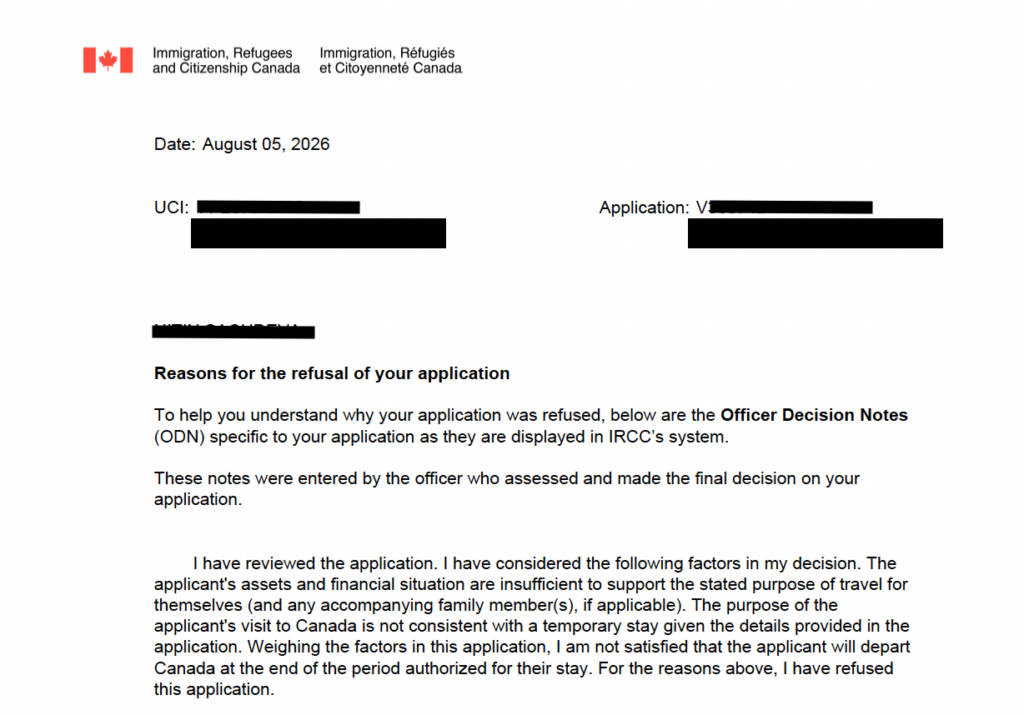
The Officer Decision Notes stated:
“The applicant’s assets and financial situation are insufficient to support the stated purpose of travel…”
The officer also concluded:
“The purpose of the applicant’s visit to Canada is not consistent with a temporary stay given the details provided in the application.”
The ultimate concern was that the officer was not satisfied that the applicant would leave Canada at the end of his authorized period of stay.
For the client, this represented his fifth refusal.
Fateh Law Corporation considered the refusal and the evidence that had actually been placed before the decision-maker. In our assessment, there were grounds to argue that the decision was unreasonable.
Rather than advising the client simply to submit application number six, we moved quickly.
August 17, 2026 — Federal Court Proceedings Commenced
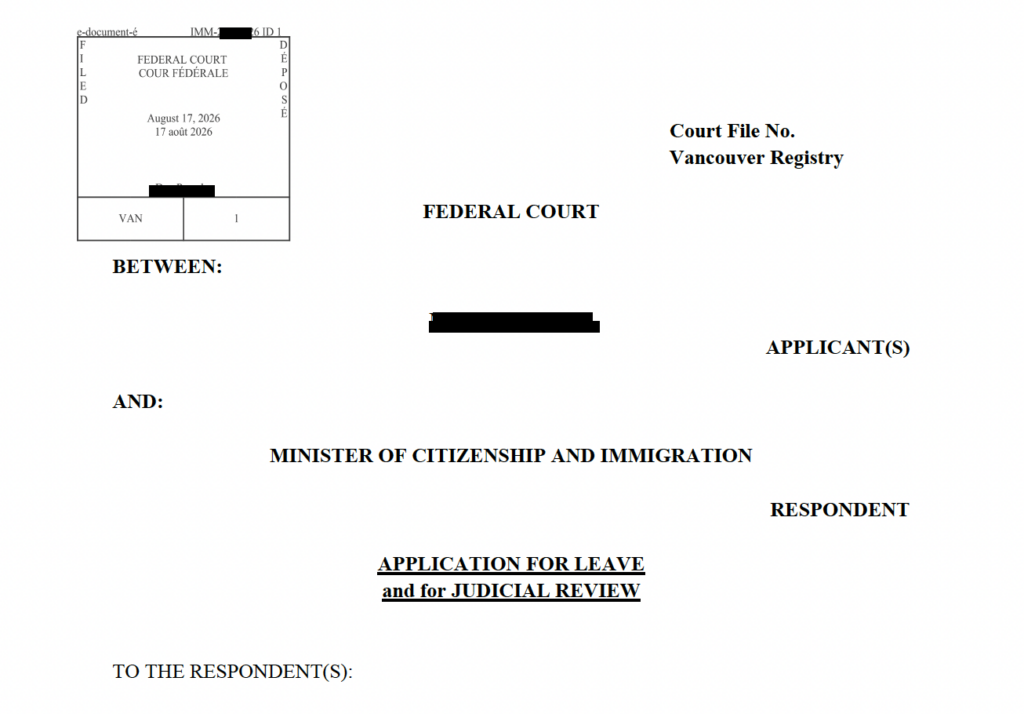
On August 17, 2026, only 12 days after the refusal, an Application for Leave and for Judicial Review was filed in the Federal Court of Canada.
The proceeding named the Minister of Citizenship and Immigration as the Respondent.
This step fundamentally changed the nature of the dispute.
The question was no longer merely whether the applicant could prepare another visitor visa application.
The legality and reasonableness of the August 5 decision itself were now being challenged through Canada’s Federal Court process.
Judicial review is not simply another visa application.
The Federal Court does not ordinarily decide whether an applicant should receive a visitor visa in place of the immigration officer. Rather, judicial review examines the legality of the administrative decision. Where appropriate, the Court may set aside an unreasonable decision and return the matter for redetermination.
That distinction is extremely important.
The Problem With Repeatedly Reapplying After Refusals
After an IRCC refusal, applicants frequently believe their only option is to apply again.
Sometimes reapplying is entirely appropriate.
Sometimes it is not.
Where the underlying weakness in an application can genuinely be corrected through new evidence or changed circumstances, a properly prepared new application may make sense.
But where substantial evidence was already before IRCC and the applicant believes the officer failed to reasonably engage with that evidence, another application may not address the real problem.
Applicants can consequently find themselves in a cycle:
Application → Refusal → Reapplication → Refusal → More documents → Reapplication → Another refusal.
Our client had reached five refusals.
At some point, an applicant should obtain legal advice about whether continuing to reapply is the appropriate strategy or whether the latest decision should instead be challenged.
Why the Financial Finding Was Significant
One of the officer’s stated concerns was the applicant’s financial situation.
But the application materials stated that the applicant had approximately ₹7.98 lakh in savings, equivalent at the time to approximately CAD $11,668.
Financial sufficiency in a visitor visa application cannot necessarily be reduced to a single number. The appropriate assessment can depend upon numerous factors, including the duration of the proposed visit, accommodation arrangements, who will pay for particular expenses, the applicant’s circumstances and the overall evidence.
The important legal issue in judicial review is therefore not simply:
“Was there money in the bank?”
The broader question can be whether the officer’s conclusion was reasonably supported by the evidence and whether the reasons adequately explain how the officer arrived at the conclusion.
That is why Federal Court litigation requires careful analysis of both the decision and the record that was actually before the decision-maker.
Judicial review is not an opportunity simply to rebuild the visa application from scratch with new evidence. Counsel must understand the evidentiary record and identify reviewable errors arising from the decision under challenge.
The Purpose of Travel: Visiting His Sister for Rakhi
The other significant concern was the finding that the client’s purpose of travel was not consistent with a temporary stay.
The proposed visit was to see his sister, who was residing in Canada as a permanent resident.
The planned travel period was approximately August 15 to August 30, with Rakhi forming an important part of the family visit.
For many families separated between India and Canada, occasions such as Rakhi have significant personal and cultural importance.
Of course, having a genuine family reason for visiting Canada does not automatically entitle anyone to a temporary resident visa. An applicant must still satisfy the applicable requirements of Canadian immigration law.
But where an officer rejects a stated family purpose, the reasons must still withstand scrutiny under the applicable administrative-law principles.
The existence of family in Canada cannot, by itself, answer every question about temporary intent.
Canadian immigration law expressly contemplates situations in which a person may have long-term immigration aspirations while nevertheless seeking temporary admission, subject to the requirements of the legislation.
Each case, however, depends upon its own evidence.
Rakhi Passed — But We Continued the Federal Court Case
There was an obvious practical problem.
Immigration litigation takes time.
The client’s intended travel was connected with Rakhi, but Rakhi was approaching rapidly. By the time the Federal Court proceeding progressed, the particular occasion the client had hoped to celebrate with his sister had already passed.
That did not mean we simply abandoned the matter.
The broader purpose remained important: the client wanted the ability to visit his sister in Canada, and there remained an outstanding refusal that we considered appropriate to challenge.
We therefore continued pursuing the matter.
A Parallel Strategy: Federal Court Litigation and Reconsideration
An important feature of this case was the strategy adopted after the refusal.
Fateh Law Corporation did not rely exclusively on waiting for the Federal Court proceeding to reach its eventual conclusion.
While pursuing the judicial review proceeding, we also pursued reconsideration with IRCC.
This created two parallel avenues:
Federal Court litigation challenging the refusal, while at the same time requesting that IRCC reconsider its decision.
This does not mean that filing a Federal Court case automatically requires IRCC to reconsider a refusal, nor does a reconsideration request guarantee that a decision will be reopened.
However, where appropriate on the particular facts, counsel can consider whether reconsideration should be pursued while litigation is ongoing.
The existence of active Federal Court proceedings also means that the challenged decision is no longer merely an ordinary closed visa file: it is the subject of formal litigation involving the Minister.
The appropriate strategy must always be determined on a case-by-case basis.
October 2026 — Legal Arguments Pursued
The Federal Court proceeding continued.
Legal arguments challenging the reasonableness of the refusal were pursued in October.
This is another important distinction between simply filing another visa application and retaining litigation counsel.
A judicial review case requires counsel to identify the alleged reviewable errors, work from the appropriate evidentiary record and advance legal arguments explaining why intervention by the Court is warranted.
Fateh Law Corporation’s practice includes litigation involving Canadian immigration decisions before the Federal Court of Canada.
With over 12 years of Canadian immigration litigation experience, our approach to a refusal is therefore not limited to asking:
“How can we submit another application?”
We also consider:
“Was the decision legally reasonable, and is there a basis to challenge it?”
October 6, 2026 — Passport Request Issued
Then came the result the client had been waiting for.
On October 6, 2026, the client’s IRCC account showed:
ORIGINAL PASSPORT REQUEST
The procedural history shown in the client’s account was striking:
July 27, 2026 — Application transmitted
August 5, 2026 — Officer Decision Note/refusal
August 17, 2026 — Federal Court judicial review proceeding filed
October 2026 — Litigation and reconsideration pursued
October 6, 2026 — Original Passport Request issued
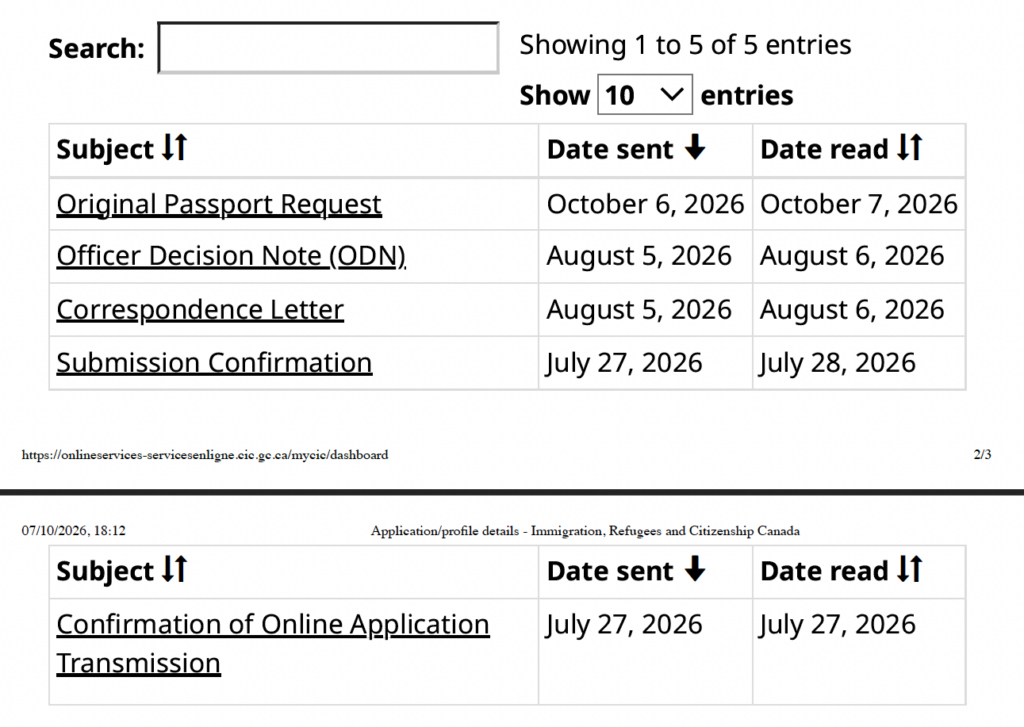
From the date the Federal Court proceeding was commenced to the passport request, only approximately seven weeks had passed.
After five refusals, the client had finally reached the passport-request stage.
Why the Speed of the Resolution Matters
Federal Court immigration litigation does not always resolve this quickly.
There is no guarantee of an early settlement or reconsideration.
Depending upon the case, litigation can continue through the leave stage and potentially to an oral judicial review hearing. Timelines vary considerably depending upon the circumstances and procedural developments.
That is why the result in this particular case was especially meaningful.
The client did not have to wait for the litigation to run all the way through to a contested oral hearing before obtaining a favourable immigration outcome.
The matter progressed from:
Refusal on August 5 → Federal Court filing on August 17 → Passport Request on October 6.
For a client who had already endured five refusals, obtaining a resolution in this timeframe was significant.
Does Filing in Federal Court Guarantee That IRCC Will Approve Your Visa?
Absolutely not.
This point deserves emphasis.
Filing an Application for Leave and for Judicial Review does not automatically overturn an immigration refusal.
It does not guarantee settlement.
It does not guarantee reconsideration.
And it certainly does not guarantee that IRCC will ultimately approve the underlying application.
Every case depends upon its facts, the evidence before the decision-maker, the reasons provided by the officer, the applicable law and the procedural history.
Past results obtained by Fateh Law Corporation cannot guarantee a similar result in another person’s case.
What experienced litigation counsel can do is assess whether there are legitimate grounds to challenge a decision and advise the client about the available legal strategy.
Federal Court Is Not Simply an “Appeal” of a Visitor Visa Refusal
Applicants should also understand that judicial review is technically different from a conventional appeal.
In most visitor visa refusal cases, there is no ordinary appeal to the Federal Court where a judge simply substitutes their own opinion for the visa officer’s decision.
Instead, an applicant generally seeks leave and judicial review.
The applicant asks the Court to review the administrative decision for legal error, including whether the decision is unreasonable or procedurally unfair.
If the applicant ultimately succeeds, the typical remedy is not for the Federal Court judge personally to issue a visa.
Rather, the impugned decision may be set aside and the matter returned for redetermination, generally by a different decision-maker.
This is why applicants should be cautious about anyone promising that filing a Federal Court case will automatically result in a visa.
There are no guaranteed outcomes in litigation.
Why Experience in Federal Court Litigation Matters
Immigration applications and immigration litigation are related, but they are not the same type of legal work.
Preparing a visitor visa application involves presenting evidence to an administrative decision-maker.
Federal Court judicial review involves litigation.
Counsel must understand administrative law, standards of review, procedural fairness, the evidentiary record, litigation deadlines, written advocacy and Federal Court procedure.
This becomes particularly important in repeated-refusal cases.
After three, four or five refusals, the question may no longer simply be what additional document can be added to another application.
The entire history may need to be examined strategically.
At Fateh Law Corporation, Canadian immigration litigation is a central part of our practice.
Mr. Fateh has over 12 years of experience as a Canadian lawyer, including experience challenging immigration decisions before the Federal Court of Canada.
That litigation perspective can be especially valuable where an applicant has experienced:
- repeated visitor visa refusals;
- study permit or work permit refusals;
- spousal or family-related immigration refusals;
- findings that appear inconsistent with the evidence;
- procedural fairness concerns;
- unreasonable credibility findings; or
- other immigration decisions potentially suitable for judicial review.
A Refusal Letter Should Not Always Be the End of the Story
A refusal letter can feel final.
It is not necessarily the end of the legal analysis.
The critical question is whether the decision is one that should simply be accepted, addressed through a new application, reconsidered by IRCC, or challenged through judicial review.
Different cases require different strategies.
In our client’s case, after five refusals, we did not believe that simply accepting the August 5 decision was the appropriate course.
The refusal was challenged.
Federal Court proceedings were commenced.
Reconsideration was pursued.
Legal arguments were advanced.
And on October 6, 2026, IRCC issued the passport request.
The client who had repeatedly been told “no” could finally move forward with visiting his sister in Canada.
Family Reunification Remains an Important Objective of Canadian Immigration Law
The Immigration and Refugee Protection Act identifies family reunification as one of the objectives of Canada’s immigration legislation.
That does not mean every person with a relative in Canada is automatically entitled to a visitor visa. Temporary residents must still satisfy the legal requirements applicable to their applications.
But the human reality behind these cases should not be forgotten.
Immigration files involve real families.
Brothers and sisters.
Parents and children.
Spouses separated across countries.
Important birthdays, weddings, births, religious occasions and family milestones can pass while an immigration application remains unresolved or after a visa has been refused.
In this case, the client hoped to visit his sister around Rakhi.
Rakhi passed while the dispute continued.
But the underlying family relationship did not disappear when the date passed.
Neither did our client’s desire to visit his sister.
So we continued.
Five Refusals Do Not Necessarily Mean the Sixth Step Should Be Another Application
This case provides an important message for applicants who have received multiple Canadian immigration refusals.
Do not assume that your only option is to keep reapplying.
There are certainly cases where another application is appropriate.
But there are also cases where an applicant should obtain legal advice about whether the latest decision itself should be challenged.
The distinction can be crucial.
If the problem is missing evidence, a stronger new application may be the answer.
If the problem is an unreasonable decision based upon evidence already provided, Federal Court judicial review may need to be considered.
And in some circumstances, counsel may consider a combination of litigation and other available legal or administrative steps.
Facing a Repeated IRCC Refusal? Speak to a Canadian Immigration Litigation Lawyer
If you have received multiple refusals from IRCC, particularly where you believe the officer’s conclusions do not reasonably reflect the evidence you submitted, consider obtaining independent legal advice promptly.
Federal Court immigration proceedings are subject to strict limitation periods. Depending upon where the matter arose, an application for leave and judicial review under the Immigration and Refugee Protection Act may generally need to be commenced within 15 days for a matter arising in Canada or 60 days for a matter arising outside Canada.
Do not wait until those deadlines have expired before obtaining legal advice.
Fateh Law Corporation focuses on Canadian immigration law and has substantial experience litigating immigration matters before the Federal Court of Canada.
With over 12 years of litigation experience, Mr. Fateh represents clients challenging allegedly unreasonable immigration decisions and advises clients on the appropriate strategy following an IRCC refusal.
Five refusals did not end this client’s case.
July 27 — Application.
August 5 — Fifth refusal.
August 17 — Federal Court challenge.
October 6 — Passport request.
Sometimes another application may be appropriate.
Sometimes it is time to challenge the decision.
Important Legal Disclaimer
This case summary has been prepared for educational and informational purposes only. Certain identifying information has been removed or redacted to protect client confidentiality.
Nothing in this article constitutes legal advice, and reading this article does not create a solicitor-client relationship with Fateh Law Corporation.
Every immigration application, refusal and judicial review proceeding is fact-specific. The appropriate legal strategy depends upon the particular decision, reasons, evidence, deadlines and circumstances of the individual case.
The outcome described above relates to one particular matter. Past results are not a guarantee of future results. A Federal Court application, reconsideration request or any other legal proceeding does not guarantee settlement, reconsideration, approval or any particular outcome.
Anyone who has received an immigration refusal should obtain independent legal advice from a qualified Canadian lawyer about their individual circumstances and any applicable limitation period.