

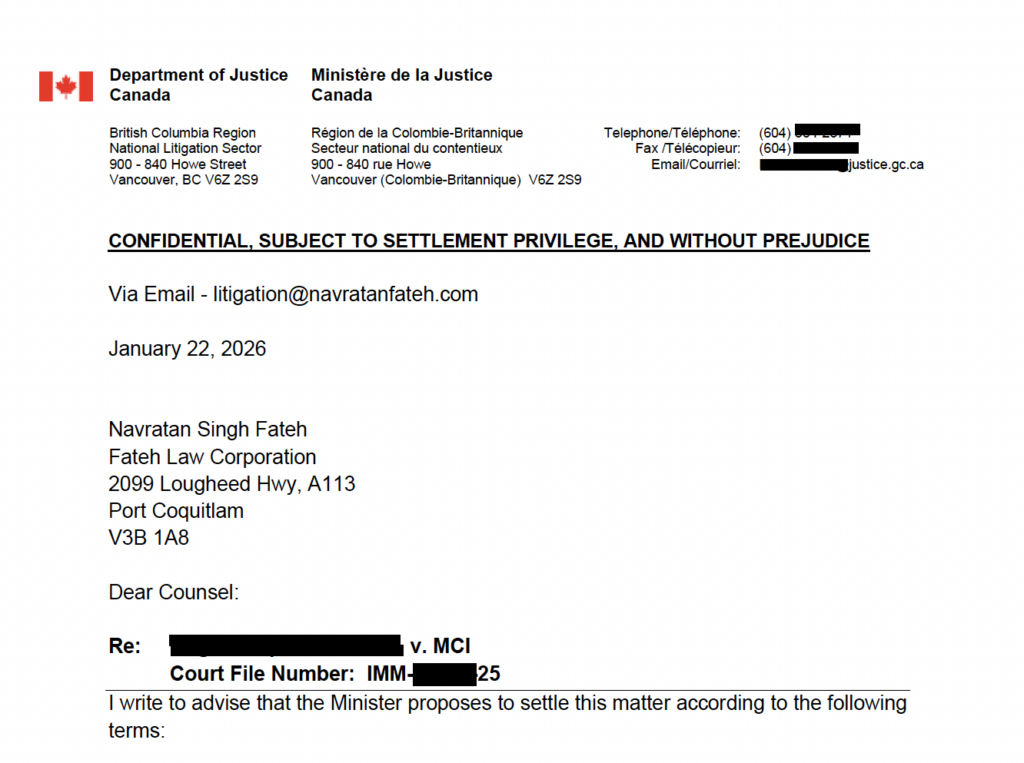
On January 22, 2026, our office at Fateh Law Corporation secured a significant settlement at the Federal Court of Canada involving a family of three a husband, wife, and their child whose visitor visa applications were refused on deeply flawed reasoning. The refusal was not based on any genuine inadmissibility, misrepresentation, or lack of documentation. Instead, the officer penalized the applicants for something entirely lawful and natural: their intention to travel to Canada together as a family.
This case highlights a troubling and increasingly common issue in Canadian visitor visa refusals families being denied simply because they apply together. It also exposes the dangerous misinformation circulating among unregulated agents who advise applicants to apply separately, often encouraging them to conceal their true intentions.
In this comprehensive blog, we will break down the legal issues, the strategy we used in Federal Court, the importance of truthful applications, and how families can properly prepare strong visitor visa applications supported by evidence, affidavits, and binding jurisprudence such as Jafari v. Canada.
The Facts of the Case
Our clients were a genuine family unit residing in India. They had stable lives, strong family connections, and clear temporary intentions to visit Canada together. Their application included:
- Financial documentation
- Travel history
- Family background
- Purpose of visit
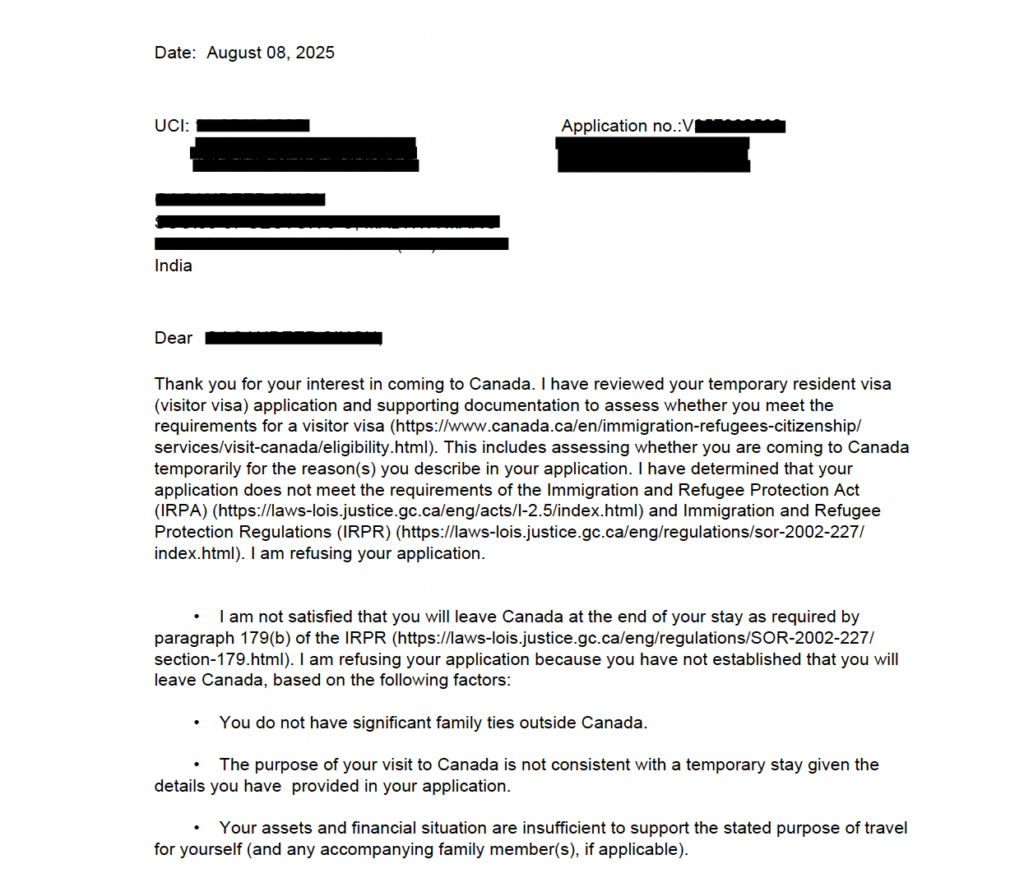
Despite this, the visa officer refused their applications, primarily on the basis that:
- They were traveling together as a family
- Their ties to Canada outweighed their ties to India
- There was insufficient evidence they would leave Canada at the end of their stay
This reasoning reflects a fundamental misunderstanding of how family-based travel should be assessed.
The Core Legal Issue: Penalizing Families for Staying Together
At the heart of this case is a simple but critical question:
Can a visa officer refuse an application simply because a family intends to travel together?
The answer, supported by Federal Court jurisprudence, is no.
When officers assume that a family traveling together has weak ties to their home country, they are effectively applying a blanket rule that undermines the individualized assessment required under Canadian immigration law.
The Dangerous Myth: “Apply Separately for Better Chances”
Many applicants come to us after being advised by agents to:
- Submit separate applications
- Avoid mentioning that family members are traveling together
- Create artificial travel plans
This advice is not only wrong—it is dangerous.
Misrepresenting your travel intentions can lead to:
- Refusal of your application
- A finding of misrepresentation
- A potential 5-year ban from entering Canada
Honesty is not optional in immigration applications—it is mandatory.
The Correct Approach: Apply Together and Tell the Truth
The proper legal strategy is to:
- Clearly state that you are traveling as a family
- Provide supporting evidence of your genuine temporary intent
- Demonstrate strong ties to your home country
Families are not required to artificially separate their applications to satisfy a flawed assumption.
Federal Court Intervention: Challenging the Refusal
Given the unreasonable nature of the refusal, we initiated a legal challenge at the Federal Court of Canada.
Our arguments focused on:
- The officer’s failure to conduct an individualized assessment
- The unreasonable assumption that traveling as a family weakens home country ties
- The lack of proper reasoning
We emphasized that the officer’s logic, if accepted, would mean:
No family traveling together could ever qualify for a visitor visa.
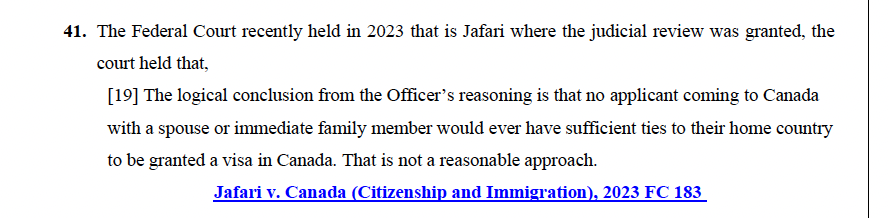
This is precisely the issue addressed in Jafari v. Canada (2023 FC 183).
Key Precedent: Jafari v. Canada (2023 FC 183)
In Jafari v. Canada, the Federal Court made an important observation:
If an officer concludes that traveling with family members automatically weakens ties to the home country, then logically.
No applicant traveling with their spouse or immediate family would ever qualify for a visa.
The Court found this reasoning to be unreasonable.
This case has become a cornerstone in challenging refusals where family unity is used against applicants.
The Settlement: January 22, 2026
Following our legal submissions, the Department of Justice agreed to a settlement.
This means:
- The refusal is set aside
- The application will be reconsidered
- A different visa officer will review the case
- The new decision must consider proper legal principles
A settlement is a strong indicator that the original decision was legally flawed.
What Happens After a Federal Court Settlement?
After a settlement:
- The file is returned to IRCC
- A new officer is assigned
- Applicants may receive an opportunity to submit additional documents
- A new decision is made
This stage is critical. It is not simply a repeat of the original process it is an opportunity to correct deficiencies and strengthen the application.
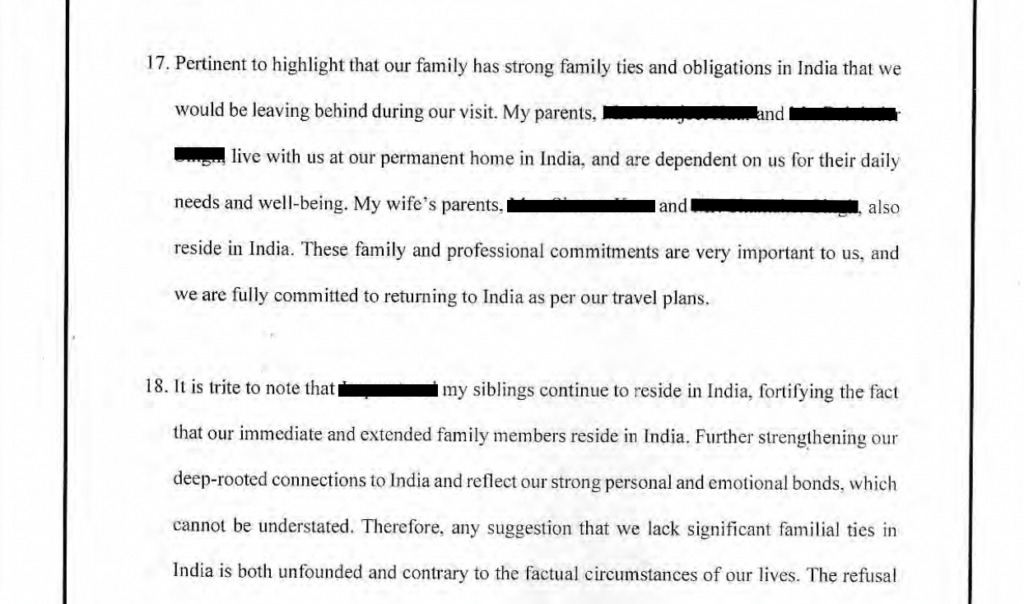
The Role of a Strong Affidavit
One of the most powerful tools in a visitor visa application is a well-drafted affidavit.
A strong affidavit should include:
1. Family Structure
Explain who you live with and your role within the family.
2. Dependents in India
Highlight parents, children, or relatives who rely on you.
3. Daily Responsibilities
Detail your routine, obligations, and commitments.
4. Cultural Context
Explain family expectations, traditions, and responsibilities in India.
5. Intent to Return
Clearly state why you must and will return after your visit.
Demonstrating Strong Ties to India
Applicants must go beyond generic statements. Strong ties include:
- Family members remaining in India
- Employment or business ownership
- Property ownership or leases
- Financial stability
- Social and cultural commitments
The goal is to show compelling reasons to return.
Legal Submissions: The Missing Piece in Most Applications
Most refusals occur because applications lack legal framing.
Legal submissions allow you to:
- Address potential concerns proactively
- Cite Federal Court decisions
- Guide the officer’s analysis
- Prevent unreasonable conclusions
Without legal submissions, officers are left to make assumptions.
Why Officers Get It Wrong
Visa officers operate under:
- High caseloads
- Limited time
- Template-based reasoning
This often leads to:
- Generic refusals
- Over-reliance on assumptions
- Failure to consider cultural realities
Federal Court intervention ensures accountability.
Cultural Context Matters
In countries like India:
- Family units are closely connected
- Joint travel is common
- Responsibilities extend beyond nuclear families
Ignoring this context leads to flawed decisions.
The Bigger Legal Principle
This case reinforces a critical principle:
👉 Immigration decisions must be reasonable, individualized, and evidence-based.
Blanket assumptions such as penalizing families for traveling together are not legally sustainable.
When Should You Go to Federal Court?
You should consider litigation if:
- Your refusal lacks clear reasoning
- The officer ignored key evidence
- You were penalized for family ties
- The decision appears unfair or illogical
Federal Court is not just an appeal it is a legal review of the decision-making process.
Why Choose Fateh Law Corporation?
At Fateh Law Corporation, we specialize in:
- Federal Court litigation
- Complex visa refusals
- Strategic legal submissions
- High-stakes immigration cases
With over a decade of litigation experience, we understand how to:
- Identify legal errors
- Build strong arguments
- Achieve meaningful results
Final Thoughts
This case is a powerful reminder that:
- Families should not be punished for staying together
- Honesty is always the best strategy
- Strong legal representation can change outcomes
The settlement on January 22, 2026, is not just a win for one family—it is a message to all applicants and decision-makers:
👉 Applying as a family is not a weakness it is a reality that must be fairly assessed.
Contact Us
If your visitor visa was refused unfairly especially due to family ties—do not accept the decision without review.
Contact Fateh Law Corporation today to explore your legal options and challenge unreasonable refusals at the Federal Court of Canada.