

A Landmark Case Demonstrating Why Wrongful IRCC Decisions Must Be Challenged
Immigration decisions are not just paperwork.
They shape families, determine futures, and often decide whether loved ones will ever reunite again.
At Fateh Law Corporation, we routinely see how a single unreasonable decision by Immigration, Refugees and Citizenship Canada (IRCC) can permanently alter a person’s life. Few cases illustrate this injustice more clearly than the case of an elderly father, educated only up to Grade 10, who was wrongly accused of misrepresentation and banned from Canada for five years—despite the officer admitting the misrepresentation was “not definite.”
This blog explains:
- What happened in this case
- Why the misrepresentation finding was legally flawed
- How cultural misunderstanding and poor interviewing lead to wrongful bans
- Why most people never challenge these decisions
- How the Federal Court of Canada intervened
- And why experienced litigation counsel is critical if your refusal is unjust
Most importantly, this blog explains why genuine applicants must not accept wrongful refusals—and how Fateh Law Corporation helps restore justice.
Understanding the Client: An Elderly Father With Limited Education
Our client was not a sophisticated traveler or a frequent international visitor.
He was:
- Elderly
- Educated only up to the 10th grade
- A devoted father
- Seeking to travel temporarily to Canada to help his daughter care for her newborn child
His intention was simple, genuine, and deeply human.
In many cultures—including South Asian cultures—it is common for parents to travel at short notice when a child needs help after childbirth. This is not unusual, suspicious, or deceptive. It is a reflection of family responsibility.
Yet this cultural reality was ignored.
Denied Boarding at New Delhi Airport: The First Shock
Before the client even reached Canada, he faced a serious and unexpected obstacle.
At the new Delhi airport, he was:
- Denied boarding
- Subjected to scrutiny without a proper explanation
- Later summoned for an interview at the Canadian Embassy in New Delhi
Denied boarding itself is an extreme step, often taken without adequate procedural fairness. For elderly applicants, this can be humiliating, distressing, and deeply confusing.
But worse was yet to come.
The Poorly Conducted Interview That Changed Everything
At the Canadian Embassy in New Delhi, the client was interviewed by an immigration officer.
This interview was deeply flawed.
Instead of accommodating the applicant’s:
- Age
- Limited education
- Cultural background
- Nervousness
The officer focused on minor inconsistencies that are common when elderly applicants explain complex documentation.
The Officer’s Allegations
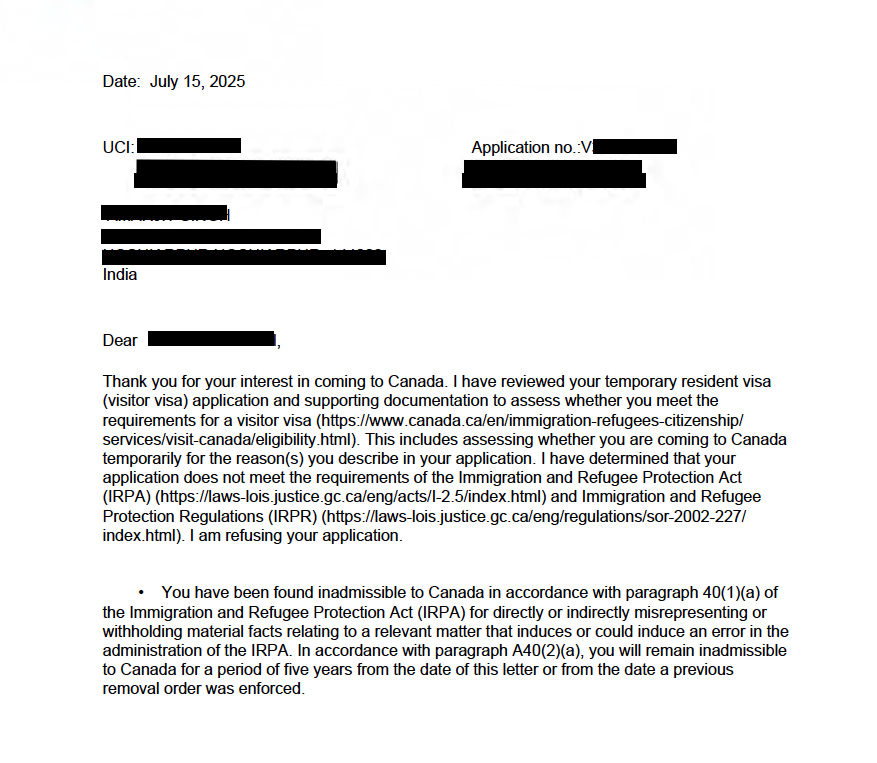
The officer imposed a misrepresentation ban based on the following points:
1. Who Filled the Application
- The client initially said he filled the application himself
- Later clarified that his daughter helped him
This is not misrepresentation.
It is normal for elderly parents to receive help from family members. The forms themselves are complex, technical, and often confusing even for educated applicants.
There was no intent to deceive.
2. Disclosure of Bank Accounts
- The client mentioned two bank accounts
- Later mentioned a third account
Again, this is not misrepresentation.
Many elderly applicants do not think in legal categories. They answer questions as they remember details. Additional disclosure does not equal deception.
In fact, voluntary disclosure strengthens credibility.
3. Purchasing Airline Tickets 10 Days Before Travel
The officer found it suspicious that tickets were purchased only 10 days before departure.
This shows a complete lack of understanding of family emergencies.
When a daughter gives birth and needs help:
- Parents do not plan months in advance
- Travel is often arranged urgently
Urgent travel does not equal fraud.
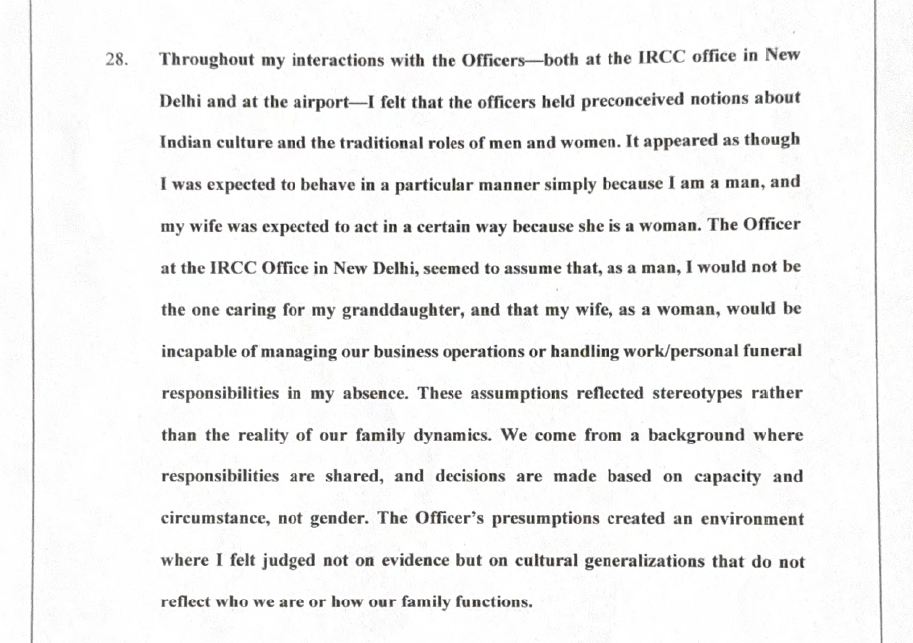
4. “Culturally Odd” Reasoning
Perhaps the most troubling reason was this:
The officer found it culturally odd that the father was travelling instead of the mother to help with the baby.
This reasoning is:
- Culturally insensitive
- Legally irrelevant
- Discriminatory in effect
Canadian immigration law does not allow officers to impose bans based on their personal views of family roles.
This alone demonstrates how deeply flawed the decision was.
The Most Shocking Detail: “Although Not Definite Misrepresentation”
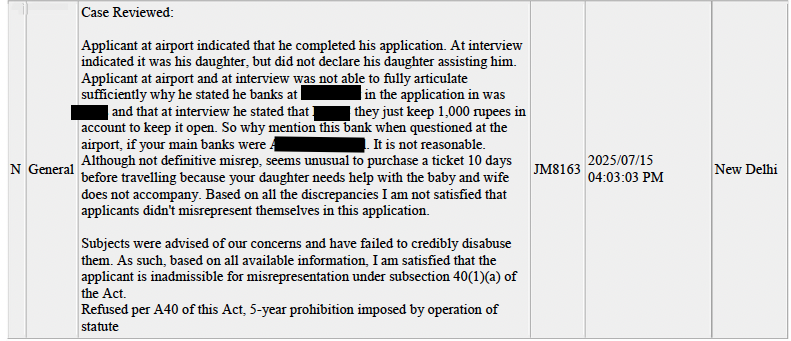
In the officer’s own notes, a crucial sentence appeared:
“Although not a definite misrepresentation.”
This single line exposed the core problem.
Even the officer:
- Was unsure
- Had doubts
- Did not find a clear misrepresentation
Yet despite this uncertainty, the officer imposed one of the harshest penalties in Canadian immigration law.
What Is a Misrepresentation Ban and Why It Is So Serious
A misrepresentation ban under Section 40 of the Immigration and Refugee Protection Act (IRPA) results in:
- A 5-year ban from Canada
- Inadmissibility across multiple visa categories
- Severe emotional and psychological distress
- Family separation
- Stigma that follows future applications
This is not a minor refusal.
It is a punishment with life-altering consequences.
Canadian law requires:
- Clear evidence
- Intent or material misrepresentation
- Proportional decision-making
None of these standards were met.
IRCC’s Failure to Consider Consequences
One of the biggest legal failures in this case was IRCC’s failure to consider the human consequences of its decision.
This elderly father:
- Could not see his daughter
- Could not meet his grandchild
- Was separated from family for five years
Administrative decision-makers must consider the impact of their decisions. This is a cornerstone of Canadian administrative law.
IRCC did not.
Why Most People Never Challenge These Decisions
Wrongful misrepresentation bans happen more often than people realize.
Yet very few applicants challenge them because:
- They are told nothing can be done
- They fear costs
- They are unaware of Federal Court remedies
- Consultants and inexperienced representatives discourage litigation
As a result, IRCC decisions often go unchallenged, allowing systemic errors to continue.
The Role of the Federal Court of Canada
The Federal Court of Canada exists precisely for cases like this.
It ensures:
- IRCC follows the law
- Decisions are reasonable
- Power is not abused
- Individuals are treated fairly
Judicial review is not a reapplication.
It is a legal challenge to the decision-making process itself.
Fateh Law Corporation’s Litigation Strategy
At Fateh Law Corporation, we carefully analyzed:
- The interview transcript
- The officer’s notes
- Applicable Federal Court jurisprudence
- Cultural context
- Procedural fairness breaches
We argued that:
- There was no clear misrepresentation
- The officer relied on speculation
- Cultural bias influenced the decision
- The consequences were ignored
- The decision was unreasonable
Costs Against the Minister: A Rare and Powerful Outcome
We did not merely challenge the refusal.
We sought costs against the Minister of Citizenship and Immigration.
This is significant because:
- Costs are not routinely granted
- They indicate serious concerns with the decision
- They send a message of accountability
Department of Justice Concedes the Error
After reviewing our arguments, the Department of Justice—representing IRCC—agreed:
- The decision was wrong
- The misrepresentation finding could not stand
This resulted in a settlement.
Settlement Achieved: January 28, 2026
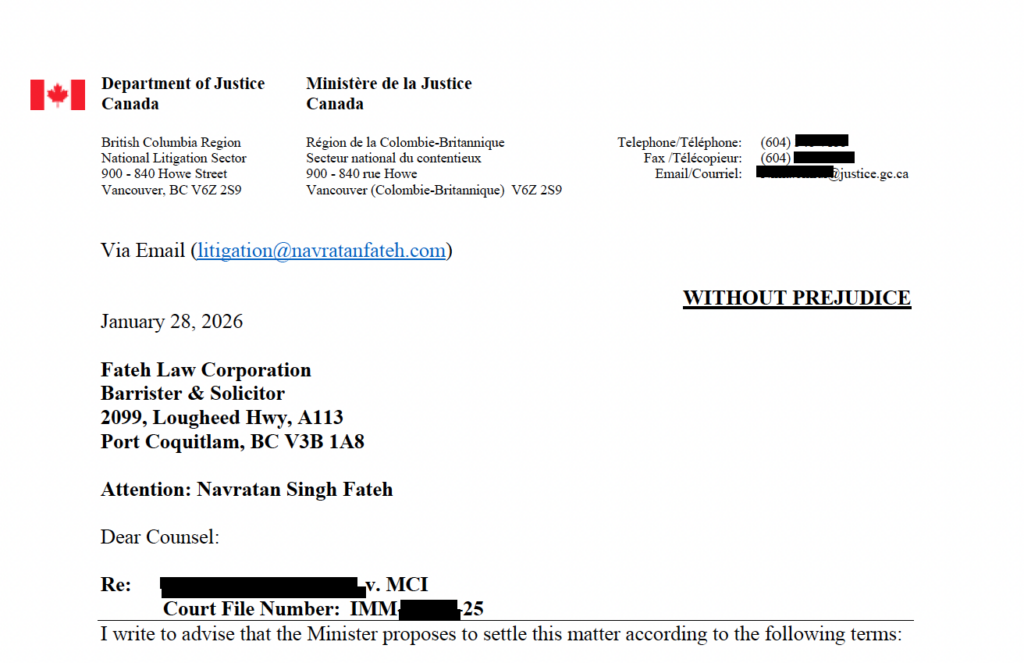 On January 28, 2026, the matter was settled.
The outcome:
- ❌ Misrepresentation ban set aside
- 🔁 Matter returned for redetermination
- 👤 Different officer to reassess the application
This restored fairness and dignity to our client.
What Happens After Redetermination
Redetermination means:
- A fresh review
- No reliance on the flawed reasoning
- Updated documentation
- Proper consideration of facts
We remain confident in securing a visa for our client.
Why This Case Matters Beyond One Client
This case highlights a systemic issue:
- IRCC sometimes relies on doubt instead of evidence
- Officers may misunderstand cultural realities
- Severe penalties are imposed too casually
Challenging such decisions protects not only one client—but the integrity of the immigration system.
Why You Need an Experienced Federal Court Lawyer
Federal Court litigation is not for beginners.
It requires:
- Legal research
- Drafting complex memoranda
- Understanding administrative law
- Strategic negotiation with the Department of Justice
Mr. Navratan Fateh has:
- Over 12 years of litigation experience
- Extensive Federal Court practice
- A proven record of setting aside wrongful refusals
Consultants and Junior Lawyers Cannot Do This Work
Many refusals fail because:
- Judicial review deadlines are missed
- Arguments are poorly framed
- Evidence is misunderstood
Immigration litigation requires specialized expertise.
When Should You Challenge IRCC in Federal Court?
You should consider Federal Court litigation if:
- A misrepresentation ban was imposed unfairly
- The officer relied on speculation
- Cultural misunderstandings influenced the decision
- The notes reveal uncertainty
- The refusal ignores humanitarian consequences
Do Not Accept an Unjust Decision
IRCC is not infallible.
Its decisions are reviewable.
And when wrong, they must be challenged.
Fateh Law Corporation: Standing Between You and Injustice
At Fateh Law Corporation, we believe:
- Power must be exercised responsibly
- Families deserve fairness
- Genuine applicants deserve protection
We do not shy away from challenging wrongful decisions—even against the Minister.
Contact Us for a Paid Consultation
If you or your family member:
- Faces a misrepresentation ban
- Has received an unreasonable refusal
- Has lost hope
📞 Contact Fateh Law Corporation for a paid consultation
Let experience, strategy, and courage work for you.
Fateh Law Corporation
Federal Court Immigration Litigation | Appeals | Judicial Reviews
Justice begins when silence ends.