

When a Visitor Visa Refusal Is Not Really About the Reasons Given
A Canadian visitor visa refusal can be devastating. For many applicants, it represents more than a missed trip — it becomes a recurring obstacle that follows them for years. This is especially true for single applicants, those who have faced multiple refusals, and individuals who are repeatedly refused on vague grounds such as purpose of visit or financial situation.
At Fateh Law Corporation, we regularly see cases where applicants are refused not because their applications are weak, but because the immigration system begins to prejudge them based on past refusals. When that happens, reapplying again and again is often futile. The correct remedy is not another application — it is litigation.
This blog discusses a real Federal Court case involving a client who was refused a Canadian visitor visa eight times, how we challenged the refusal through judicial review, and how the Department of Justice ultimately agreed to settle, ordering a fresh decision by a different officer.
More importantly, this case highlights a critical legal principle:
Visa officers are allowed to refuse applications — but they must do so fairly, reasonably, and with genuine analysis.
Background of the Case: Eight Visitor Visa Refusals
Our client was a single applicant who had applied for a Canadian visitor visa multiple times over several years. Each application was supported by documentation addressing the officer’s concerns, yet the refusals continued.
By the time the most recent refusal was issued, our client had been refused eight times.
The September 4, 2025 Refusal
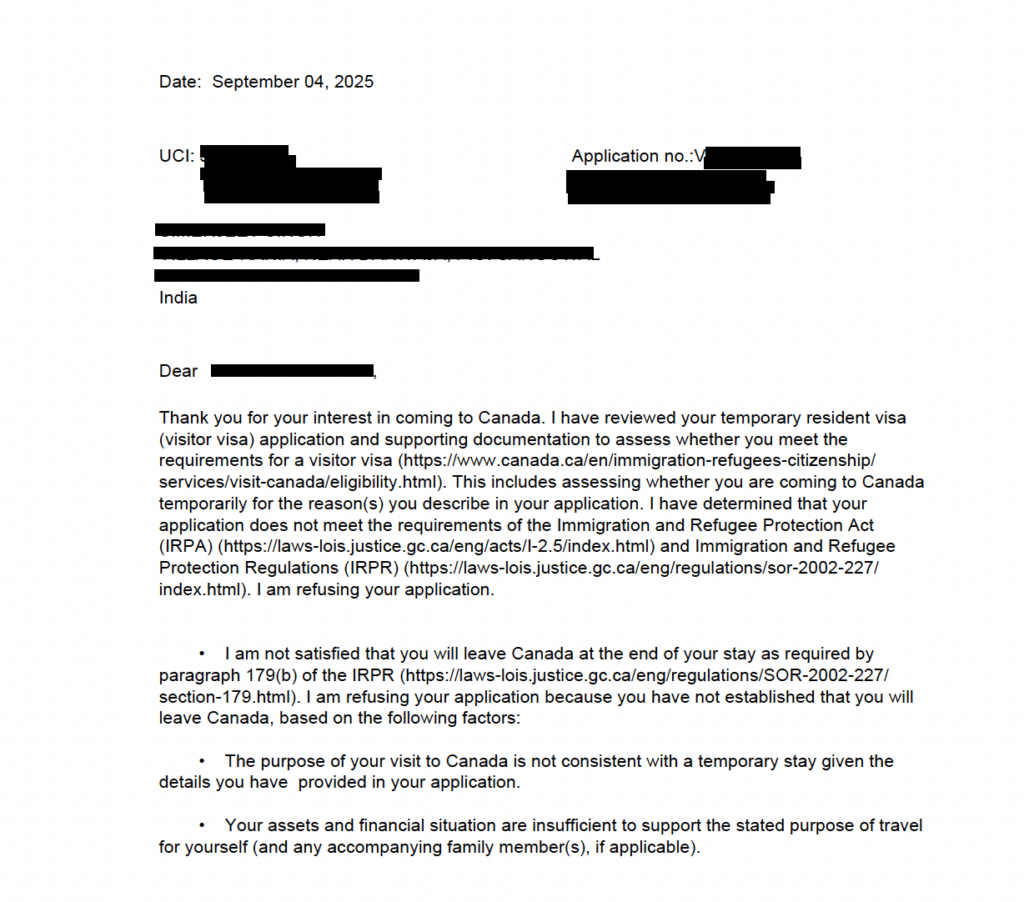
On September 4, 2025, IRCC refused the application citing the familiar and often overused reasons:
- ❌ Purpose of visit
- ❌ Assets and financial situation
On paper, these reasons may appear legitimate. In reality, they are frequently used as boilerplate refusal grounds, especially in cases involving single applicants or those with a history of refusals.
What made this refusal particularly troubling was not just the outcome — but the lack of meaningful engagement with the evidence submitted.
The Real Issue: Bias Arising from Multiple Refusals
In immigration law, each application must be assessed independently. Prior refusals can be considered, but they cannot replace a genuine analysis of the current application.
In this case, the refusal reasons were superficial and mechanical. The officer did not meaningfully explain:
- Why the stated purpose of visit was not credible
- Why the financial evidence was insufficient
- How the current application failed despite addressing previous concerns
This raised a serious legal concern: Was the officer actually refusing the application because of the evidence — or because of the client’s refusal history?
Our position was clear:
👉 The refusal was driven by prejudice arising from multiple past refusals, not a fair assessment of the current application.
The Affidavit: A Critical Piece of Evidence Ignored
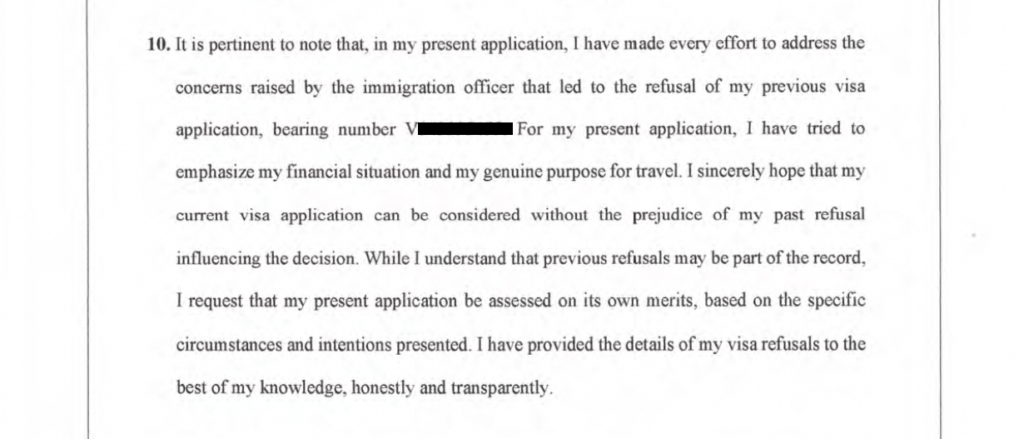
One of the most important aspects of this case was the sworn affidavit submitted by the client with the application.
In that affidavit, the client:
- ✔️ Explicitly acknowledged all prior refusals
- ✔️ Explained how the current application addressed earlier concerns
- ✔️ Clarified the purpose of the visit
- ✔️ Detailed assets, income, and financial capacity
- ✔️ Respectfully requested that past refusals not prejudice the present application
Despite this, the refusal decision made no meaningful reference to the affidavit. This omission was legally significant.
Canadian courts have consistently held that decision-makers must engage with key evidence. Ignoring critical evidence — especially sworn testimony — renders a decision unreasonable.
Legal Notice to IRCC: Attempting Reconsideration
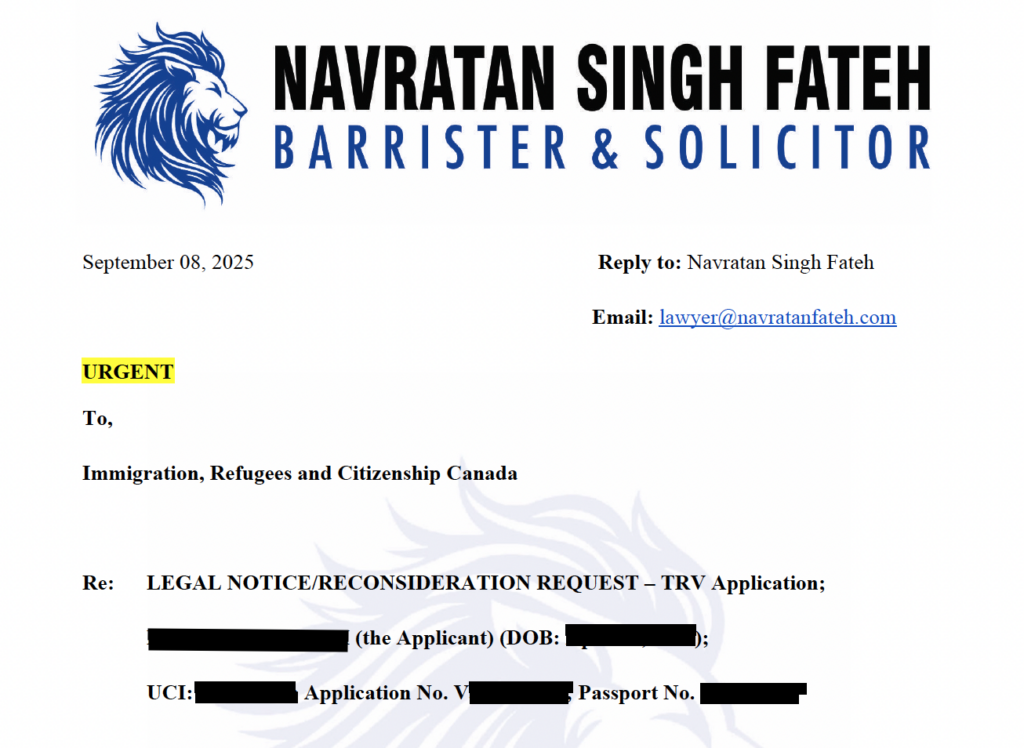
Before commencing judicial review, we took a strategic step that many firms overlook.
On September 8, 2025, just days after the refusal, Fateh Law Corporation served a formal legal notice to IRCC, requesting reconsideration of the decision.
Why Legal Notices Matter
A legal notice serves several purposes:
- It alerts IRCC to legal defects in the decision
- It gives the decision-maker an opportunity to correct the error
- It strengthens the applicant’s position before the Federal Court
- It demonstrates procedural fairness and good faith
In this case, IRCC declined to reconsider.
That refusal left only one viable remedy: Judicial Review at the Federal Court of Canada.
Judicial Review: Holding IRCC Accountable
Judicial review is not an appeal. The Federal Court does not substitute its own decision for that of the visa officer. Instead, it examines whether the decision was:
- Reasonable
- Justified
- Transparent
- Intelligible
In visitor visa refusal cases, the standard applied is reasonableness.
Our Core Arguments Before the Federal Court
We argued that:
- The officer failed to conduct a genuine analysis of the application
- The refusal relied on boilerplate language
- The officer ignored critical affidavit evidence
- The decision was tainted by bias arising from multiple past refusals
- The reasons were inadequate and unintelligible
In short, the decision did not meet the legal standard required by Canadian administrative law.
Boilerplate Refusals: A Systemic Problem
Many visitor visa refusals rely on generic language such as:
- “I am not satisfied that you will leave Canada at the end of your stay”
- “Your assets and financial situation are insufficient”
- “Your purpose of visit is not credible”
While these phrases appear lawful, courts have repeatedly held that they must be supported by actual reasoning.
A refusal is not reasonable simply because it uses the correct words.
It must explain why the officer reached that conclusion based on the evidence.
In this case, the repetition of the same refusal grounds — despite new and improved evidence — strongly suggested mechanical decision-making.
Settlement by the Department of Justice: January 22, 2026
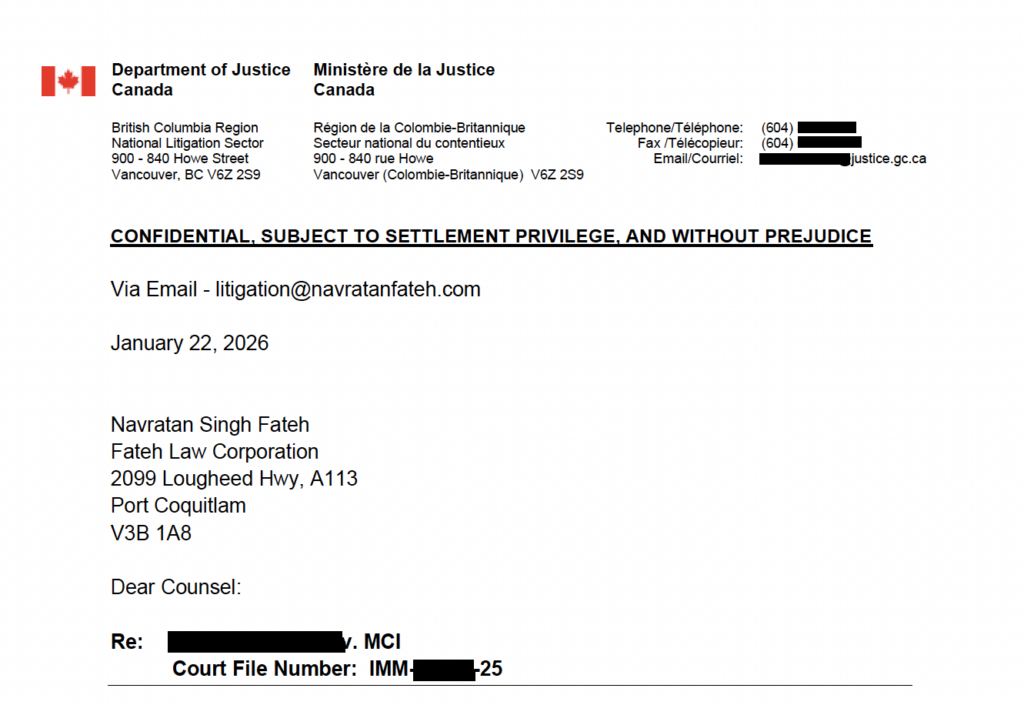
After reviewing our submissions, the Department of Justice agreed with our position.
On January 22, 2026, the matter was settled.
What the Settlement Means
- ✅ The refusal decision was set aside
- ✅ The application will be redetermined by a different officer
- ✅ The new officer must conduct a fresh, unbiased analysis
Importantly, a settlement reflects the government’s acknowledgment that the original decision could not withstand judicial scrutiny.
Breaking the Chain of Multiple Refusals
Multiple refusals often create a vicious cycle:
- Refusal issued
- Applicant reapplies
- Officer focuses on refusal history
- New refusal issued
- Cycle repeats
Judicial review is often the only effective way to break this cycle.
By forcing IRCC to reassess the application without prejudice, litigation resets the process and restores fairness.
Key Legal Principles Reinforced by This Case
1. Officers Must Provide Real Reasons
Reasons must be intelligible and responsive to the evidence.
2. Past Refusals Are Not a Shortcut
Each application must stand on its own merits.
3. Evidence Cannot Be Ignored
Affidavits and explanations must be meaningfully addressed.
4. Justice Must Actually Be Done
As famously stated:
“Justice must not only be done, but must also be seen to be done.”
— Lord Hewart, Rex v Sussex Justices (1924)
This principle applies squarely to immigration decision-making.
Why Reapplying Is Often the Wrong Strategy
Many applicants are advised to “just reapply with stronger documents.” While this may work in some cases, it is dangerous advice when:
- You have multiple refusals
- Reasons are repetitive and vague
- Evidence is consistently ignored
- The decision appears predetermined
In such cases, reapplying only strengthens the refusal narrative.
Litigation is not aggressive — it is corrective.
Why Choose Fateh Law Corporation
Fateh Law Corporation is not a volume-based immigration consultancy. We are a litigation-focused law firm with extensive experience in:
- Federal Court judicial reviews
- Challenging unreasonable visa refusals
- Addressing officer bias and procedural unfairness
- Drafting strong affidavits and legal submissions
We understand that immigration cases are not just paperwork — they are about fairness, dignity, and accountability.
Who Should Contact Us
You should consider speaking with us if:
- Your visitor visa has been refused multiple times
- You are repeatedly refused on the same generic grounds
- You believe the officer did not read your application
- You feel you are being prejudged due to past refusals
- You want a Federal Court immigration lawyer, not another reapplication
Conclusion: Refusals Are Not the End of the Road
Canadian immigration officers have discretion — but not unchecked power.
When decisions become mechanical, biased, or unreasonable, the Federal Court exists to correct them.
This case demonstrates that justice is achievable, even after eight refusals.
If you are tired of unreasonable visitor visa refusals and want a strategic, litigation-driven approach, Fateh Law Corporation is here to help.
📞 Contact Fateh Law Corporation
Federal Court Immigration Litigation
Because fairness in immigration is not optional — it is the law.