

Understanding Historical ENF 2/OP 18 Guidance on Mistakes, Misunderstandings and Section 40 of IRPA
A mistake on a Canadian immigration application can be frightening—particularly when an applicant receives a Procedural Fairness Letter alleging misrepresentation under section 40 of the Immigration and Refugee Protection Act (IRPA).
But an important question arises:
Should every incorrect answer, forgotten fact or misunderstanding automatically result in a finding of misrepresentation and serious immigration consequences?
The historical ENF 2/OP 18 – Evaluating Inadmissibility operational guidelines provide useful educational insight into this question.
In the previous Fateh Law Corporation article, we discussed examples contained in section 10.10 of the historical guidance of circumstances that would generally constitute misrepresentation.
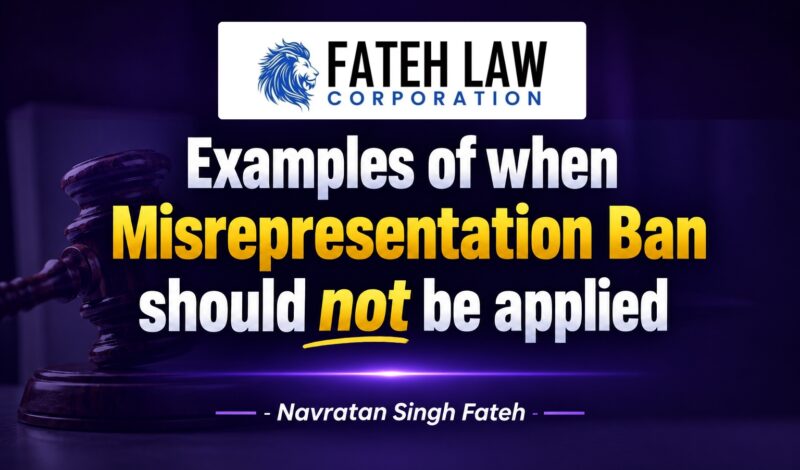
This article looks at the other side of the guidance: examples that the 2015 manual said would not generally constitute misrepresentation, particularly certain mistakes or misunderstandings.
The examples are valuable because they illustrate that the factual circumstances surrounding an incorrect answer can matter greatly.
However, there is an extremely important warning.
LEGAL DISCLAIMER: This article is for general educational and informational purposes only. It is not legal advice. ENF 2/OP 18 is historical operational guidance, and the examples discussed below should not be treated as a complete or current statement of Canadian immigration law, IRCC policy or Federal Court jurisprudence. Every section 40 case is fact-specific. Anyone facing a potential misrepresentation allegation should obtain independent legal advice from a qualified Canadian immigration lawyer concerning their particular facts and evidence.
What Is Misrepresentation Under Section 40?
IRCC currently describes misrepresentation as including providing false information or withholding information directly related to decisions made under IRPA.
The consequences can be severe. IRCC warns that providing false information can result in refusal and may also result in a person being forbidden from entering Canada for at least five years, among other potential consequences.
This makes the distinction between an incorrect answer and a legally sustainable finding of misrepresentation extremely important.
An immigration application may contain an error for many different reasons.
Someone may reverse the day and month of their birth. Someone may misunderstand a question. Someone may genuinely forget an old immigration event. Someone may misunderstand the legal meaning of “denied entry.” Someone may provide an incorrect marital-status description without intending to conceal a relationship.
But applicants should also be very careful with the phrase “honest mistake.”
It is dangerous to assume that simply saying “I made an honest mistake” defeats a section 40 allegation.
IRCC has summarized Federal Court jurisprudence as recognizing only a narrow innocent-mistake exception, applying in extraordinary circumstances where the applicant honestly and reasonably believed they were not misrepresenting or withholding a material fact and the knowledge of the misrepresentation was beyond their control.
That is one reason individualized legal advice is so important.
What Did the Historical ENF 2/OP 18 Guidelines Say?
The version of ENF 2/OP 18 – Evaluating Inadmissibility supplied for this article is dated August 1, 2015.
Section 10.10 first provided examples of situations that would generally constitute misrepresentation.
It then provided another category:
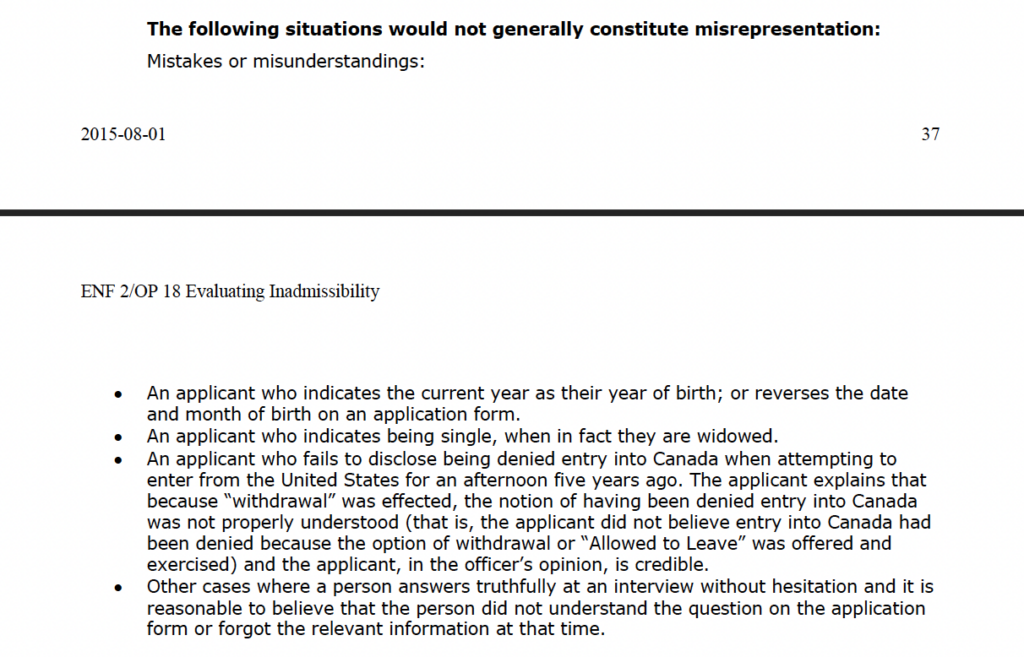
“The following situations would not generally constitute misrepresentation: Mistakes or misunderstandings”
Four examples were given.
These historical examples are particularly interesting because they illustrate circumstances in which incorrect information could exist, yet the surrounding facts could potentially point toward a genuine mistake or misunderstanding rather than a situation warranting a misrepresentation finding.
Let us examine each example.
Example 1: An Obvious Mistake in a Date of Birth
The first historical example concerns an applicant who:
indicates the current year as their year of birth, or reverses the date and month of birth on an application form.
This is an excellent illustration of what may appear to be an obvious clerical or data-entry error.
Imagine an applicant born on May 10 accidentally entering the date as October 5 because of confusion between date formats.
Or imagine an applicant accidentally typing the current year into the year-of-birth field.
The information is technically incorrect.
But the surrounding circumstances may make the nature of the mistake apparent.
For example, an application may contain the applicant’s passport showing the correct date of birth. Other supporting documents may consistently show the same correct date. Nothing may suggest that changing the date would give the applicant an immigration advantage.
That factual context can matter.
An Incorrect Answer Does Not Tell the Whole Story
This historical example teaches an important lesson:
The existence of inaccurate information and the legal conclusion that section 40 applies are not necessarily the same inquiry.
The officer must assess the circumstances of the individual case.
Was it a typographical error?
Was there contradictory information elsewhere in the application?
Was the correct information already disclosed?
Was there a plausible explanation?
Was the incorrect information capable of affecting the immigration process?
These are precisely the types of questions that demonstrate why section 40 cases require careful legal analysis.
Example 2: Describing Yourself as “Single” When You Are Widowed
The second historical example is particularly interesting.
It concerns:
an applicant who indicates being single when, in fact, they are widowed.
Again, the information is technically inaccurate.
“Single” and “widowed” are not necessarily interchangeable categories on an immigration form.
Nevertheless, the historical guidance identified this as an example that would not generally constitute misrepresentation.
Why is this important?
Because applicants sometimes misunderstand how immigration forms use particular terms.
In ordinary conversation, a widowed person might consider themselves “single” because they are no longer married.
An immigration form, however, may distinguish among categories such as:
- single;
- married;
- common-law;
- separated;
- divorced; and
- widowed.
A person unfamiliar with these distinctions may misunderstand the question.
But this example should not be interpreted as permission to select whichever marital status an applicant prefers.
Marital and family information can be extremely important in Canadian immigration proceedings.
The historical example instead demonstrates why the nature of the error, surrounding evidence and applicant’s explanation can matter.
Example 3: Failing to Disclose an Old Denial of Entry Because the Applicant Believed They Had “Withdrawn”
The third example is more complicated and perhaps one of the most useful examples in the historical guidance.
It concerns an applicant who failed to disclose that they had been denied entry into Canada when attempting to enter from the United States for an afternoon approximately five years earlier.
According to the historical example, a withdrawal had been effected.
The applicant explained that they did not properly understand that they had been denied entry because they had been given and exercised the option to withdraw or were “Allowed to Leave.”
Importantly, the historical example adds another factor:
The officer considered the applicant credible.
This detail is significant.
The example was not simply:
“The applicant forgot an old border incident, therefore there is no misrepresentation.”
Instead, there was a factual explanation for the misunderstanding, and the officer found the applicant credible.
Why This Example Matters
Immigration terminology is not always understood by members of the public.
An applicant may have arrived at a Canadian port of entry years earlier, spoken with a border officer, been given documents and returned to the United States.
The applicant may genuinely remember the event as:
“I decided not to enter Canada.”
The immigration record may characterize the event differently.
Whether such an omission amounts to misrepresentation cannot safely be determined from a generic online example.
The actual documentation, questions asked on the application, immigration history, applicant’s understanding and explanation may all need to be examined.
Credibility can matter enormously.
If an officer accepts that an applicant genuinely misunderstood what occurred, that factual conclusion may be relevant to the analysis.
Conversely, merely asserting “I misunderstood” does not automatically establish that explanation.
That is why independent legal advice is particularly important where IRCC raises a historical immigration event as a possible misrepresentation.
Example 4: Truthfully Answering at an Interview After Misunderstanding or Forgetting a Question
The fourth historical example is especially important.
The guidance referred to cases where a person:
- answers truthfully during an interview;
- does so without hesitation; and
- the circumstances reasonably support the conclusion that the person either did not understand the question on the application form or had forgotten the relevant information at the time.
This example demonstrates the importance of looking beyond a single incorrect box on a form.
Suppose an applicant provides an inaccurate answer on an application but, when directly questioned by an officer, immediately provides the correct information.
That conduct may be relevant to determining what actually happened.
Was there an attempt to conceal something?
Was the original question misunderstood?
Had the applicant simply forgotten an event?
Did the applicant immediately disclose the information when the question became clear?
Were their answers consistent with other evidence?
Did the applicant have any reason to hide the information?
The answers may be highly relevant to the assessment.
But again, this historical example should not be converted into a universal rule that correcting information later automatically eliminates a potential section 40 problem.
Every case depends upon its particular circumstances.
The Four Historical Examples at a Glance
The 2015 ENF 2/OP 18 material supplied for this article identified these situations as ones that would not generally constitute misrepresentation under its “mistakes or misunderstandings” category:
- Date-of-birth error: entering the current year as the year of birth or reversing the month and date.
- Marital-status misunderstanding: indicating “single” when actually widowed.
- Misunderstanding an old border event: failing to disclose a previous denial of entry where withdrawal or “Allowed to Leave” had been offered and exercised, the applicant genuinely did not understand that they had been denied entry, and the officer considered the applicant credible.
- Misunderstanding or forgetting information on an application: where the person later answers truthfully and without hesitation at an interview and it is reasonable to believe that they misunderstood the original question or forgot the relevant information at the time.
These examples are useful educational illustrations.
They are not safe-harbour rules and should not be treated as a legal test for present-day applications.
Does an “Honest Mistake” Automatically Defeat Misrepresentation?
No.
This distinction is extremely important.
An applicant should not read the historical examples and conclude:
“My mistake was innocent, so section 40 cannot apply to me.”
Canadian misrepresentation jurisprudence is considerably more nuanced.
IRCC itself has summarized the Federal Court’s jurisprudence by stating that applicants are responsible for their applications and that the innocent-mistake exception recognized by the courts is narrow.
This means that intent is not the only issue.
Likewise, an applicant cannot necessarily avoid responsibility simply because another person prepared or submitted the application. IRCC’s summary of the jurisprudence states that an applicant may be found inadmissible even where fraudulent information was provided by their representative, depending on the circumstances.
That distinction is crucial.
The historical ENF 2/OP 18 examples help us understand the circumstances officers were instructed to consider. They should not be transformed into a general proposition that all accidental inaccuracies are legally excused.
Materiality Is Important
Section 40 cases also involve the concept of materiality.
The statutory concept of misrepresentation is concerned with misrepresenting or withholding material facts relating to a relevant matter that induces or could induce an error in the administration of IRPA.
This is another reason that context matters.
Consider the difference between accidentally reversing two numbers in a date where the correct information is obvious from the passport and deliberately changing information that could affect eligibility for an immigration program.
Those situations are not necessarily equivalent.
But determining whether an error was material—and how the applicable jurisprudence applies—is a legal analysis.
Applicants should therefore resist trying to determine their own case simply by comparing it to one example from an operational manual.
What Should You Do If You Discover an Honest Mistake After Submission?
One of the most stressful situations occurs when an applicant submits an immigration application and later realizes:
“I answered something incorrectly.”
The instinct may be to panic.
Another instinct may be to ignore the problem and hope that IRCC does not notice.
Neither is a substitute for obtaining appropriate advice.
Depending upon the circumstances, a lawyer may need to consider:
What exactly was incorrect? What question was asked? What should the correct answer have been? Is the information potentially material? What evidence establishes that it was an error? Has IRCC already identified the issue? Has a decision already been made? Should a correction or explanation be submitted? Could explaining create other immigration consequences?
There is no universal answer.
Seek independent legal advice before deciding how to address a potentially material error.
What If You Receive a Procedural Fairness Letter Alleging Misrepresentation?
A Procedural Fairness Letter (PFL) raising section 40 concerns should be treated seriously.
This may be the applicant’s opportunity to respond to the officer’s concerns before a final adverse determination is made.
A proper response may require reviewing much more than the PFL itself.
Depending upon the case, counsel may need to examine:
- the exact wording of the application question;
- every version of the application submitted;
- supporting documents;
- previous immigration applications;
- GCMS records;
- previous refusals;
- border or immigration history;
- communications with representatives;
- the allegedly incorrect information;
- evidence supporting the applicant’s explanation;
- materiality;
- credibility considerations;
- applicable IRPA provisions; and
- current Federal Court jurisprudence.
An applicant should not assume that a short statement saying “this was an honest mistake” will necessarily resolve the allegation.
The explanation should be assessed in the context of the evidence and applicable law.
What If Your Immigration Consultant or Agent Made the Error?
This is another difficult area.
Applicants sometimes discover that information submitted by a representative was inaccurate.
They may say:
“I didn’t write it. My agent did.”
Unfortunately, that fact alone should not be assumed to resolve a section 40 allegation.
IRCC publicly states that applicants remain responsible for information in their applications, and its summary of Federal Court jurisprudence notes that misrepresentation can potentially be found even where fraudulent information originated with a representative.
The precise facts still matter enormously.
What information did the applicant give the representative?
Did the applicant review the forms?
Were documents altered without the applicant’s knowledge?
Was the applicant told something incorrect?
Could the applicant reasonably have known about the false information?
What evidence exists showing what happened?
Those are potentially important questions requiring individualized legal assessment.
Historical Operational Guidance Is Not the Same as Current Law
This point deserves special emphasis.
The ENF 2/OP 18 document discussed in this article is historical guidance dated August 1, 2015.
Canadian immigration law and administrative practices evolve.
Federal Court decisions continue to interpret section 40. IRCC and CBSA policies and operational instructions may change. The statutory framework must be considered as it exists at the relevant time.
The historical guidance is therefore being discussed because it provides valuable educational context, not because Fateh Law Corporation is suggesting that a 2015 operational manual conclusively determines how a present-day case must be decided.
Current Government of Canada materials continue to characterize misrepresentation as a serious ground of inadmissibility, including situations involving false information or withholding relevant information.
Why Independent Legal Advice Matters
The difference between a harmless clerical mistake and a legally significant misrepresentation allegation can be enormous.
Consider two applicants who both entered incorrect information.
The first applicant may have made an obvious typographical mistake that is contradicted by accurate documents submitted with the same application.
The second applicant may have omitted information that directly affected their eligibility.
Simply saying that both applications contain a “mistake” tells us very little.
Immigration law requires analysis of the facts, evidence and law—not labels.
This is particularly important because the consequences of a section 40 finding can extend far beyond the immediate application. IRCC warns that false information can result in refusal and potentially being forbidden from entering Canada for at least five years.
Fateh Law Corporation: Section 40 and Federal Court Matters
Fateh Law Corporation practices Canadian immigration law, including immigration litigation before the Federal Court of Canada.
Where a client approaches the firm with a potential misrepresentation issue, the important question is not simply:
“Was there a mistake?”
The legal analysis may instead require asking:
What exactly happened, why did it happen, what did the applicant know, what information was before the officer, was the information material, was procedural fairness provided, and is the ultimate decision reasonable in light of the evidence and applicable law?
If a misrepresentation finding has already been made, the available legal options will depend upon the particular decision, its reasons, the record and the applicable deadlines.
Clients should therefore obtain legal advice promptly rather than relying upon another person’s case or a social-media example.
The Most Important Lesson From These Historical Examples
The historical ENF 2/OP 18 examples provide an important educational reminder:
Not every incorrect answer should automatically be treated the same way.
The guidance itself recognized examples involving mistakes and misunderstandings that would not generally constitute misrepresentation.
But the opposite warning is equally important:
Not every mistake described as “honest” is legally exempt from section 40.
The innocent-mistake concept in Canadian immigration jurisprudence is narrow.
The facts matter.
The evidence matters.
The wording of the application matters.
Materiality matters.
Credibility may matter.
And current law and Federal Court jurisprudence matter.
That is why generalized online information—even information published by Fateh Law Corporation—should never replace independent advice concerning an individual’s immigration case.
IMPORTANT LEGAL & EDUCATIONAL DISCLAIMER
This article is published by Fateh Law Corporation strictly for general educational and informational purposes. It is not legal advice and should not be relied upon as legal advice. Reading this article does not create a solicitor-client relationship.
The ENF 2/OP 18 examples discussed in this article come from historical operational guidance dated August 1, 2015 supplied for educational discussion. The material should not be regarded as an exhaustive or necessarily current statement of Canadian immigration law, current IRCC or CBSA policy, or Federal Court jurisprudence.
The fact that someone’s circumstances appear similar to one of these historical examples does not mean that section 40 will not apply to their case.
Likewise, the fact that an applicant believes an error was an “honest mistake” does not automatically establish a legal defence to a misrepresentation allegation.
Every immigration case is fact-specific. Independent legal advice from a qualified Canadian immigration lawyer should be considered whenever an applicant faces a possible misrepresentation issue, and particularly where IRCC has issued a Procedural Fairness Letter or already made a section 40 finding.