

A finding of misrepresentation under section 40 of the Immigration and Refugee Protection Act (IRPA) can have extremely serious consequences for a person seeking to enter or remain in Canada.
Misrepresentation is not limited to submitting an obviously fraudulent document. IRCC currently describes misrepresentation as including both providing false information and withholding information directly related to a decision under IRPA.
A misrepresentation finding can lead not only to refusal of an immigration application but potentially to inadmissibility to Canada for five years. IRCC’s current public guidance warns that providing false information can result in refusal and being forbidden from entering Canada for at least five years, among other potential consequences.
Because the consequences are so significant, it is important to understand the types of circumstances that immigration authorities have historically considered capable of constituting misrepresentation.
At Fateh Law Corporation, we are sharing this article strictly for legal education and public awareness. It discusses examples contained in the historical ENF 2/OP 18 – Evaluating Inadmissibility operational guidance, including section 10.10 of the version dated August 1, 2015 shown in the material reproduced for this article.
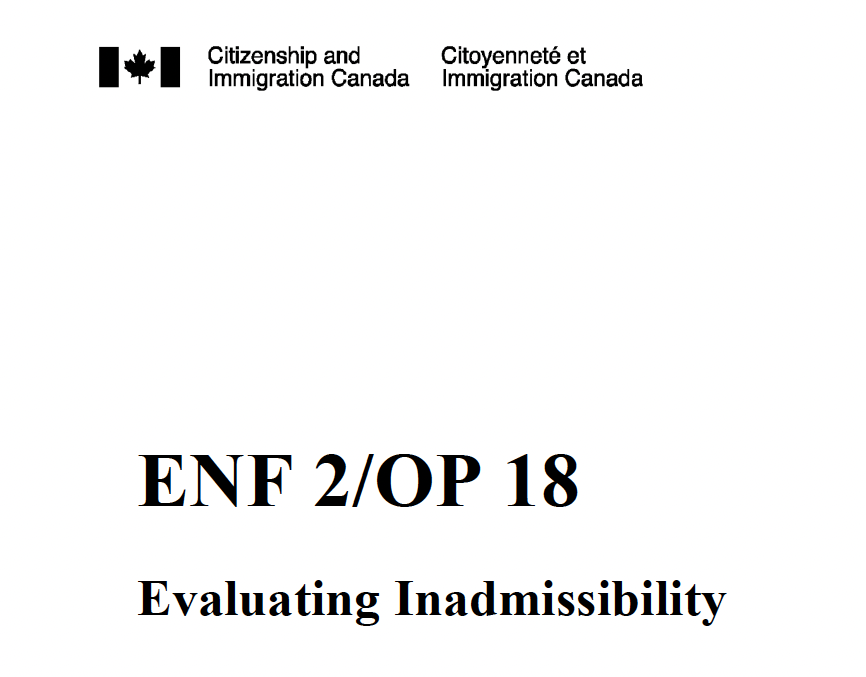
IMPORTANT DISCLAIMER: This article is provided for general educational and informational purposes only. It is not legal advice. ENF 2/OP 18 is historical operational guidance and should not be treated as a complete statement of current Canadian immigration law, current IRCC policy, or current Federal Court jurisprudence. Every misrepresentation case is fact-specific. Anyone facing an allegation or finding of misrepresentation should obtain advice from a qualified Canadian immigration lawyer based on the particular facts and evidence in their case.
What Is Section 40 Misrepresentation?
Section 40 of IRPA deals with inadmissibility for misrepresentation.
In general terms, the provision can apply where a permanent resident or foreign national directly or indirectly misrepresents or withholds material facts relating to a relevant matter that induces or could induce an error in the administration of IRPA.
That wording is important.
Applicants sometimes assume that a misrepresentation finding requires proof that they deliberately lied to an immigration officer. That is too simplistic.
Similarly, the fact that incorrect information appears somewhere in an application does not mean that every mistake automatically results in a five-year inadmissibility finding.
The legal analysis can involve questions such as:
What information was provided or withheld? Was it accurate? Was the information material? Could the information have induced an error in the administration of IRPA? What did the application actually ask? What explanation does the applicant have? What documents were before the officer? Were there procedural fairness concerns? Does an exception recognized by law apply?
These questions demonstrate why misrepresentation cases should not be decided through general statements on social media.
They require examination of the actual application, forms, supporting documents, GCMS notes, correspondence, procedural fairness letters, responses and reasons for decision.
Why Are the Historical ENF 2/OP 18 Guidelines Useful?
Mr. Navratan Singh Fateh was called to the Canadian Bar in 2014 and has more than 12 years of experience as a Canadian lawyer.
The historical ENF 2/OP 18 operational guidance was an important educational resource for understanding how immigration officers were instructed to approach questions of inadmissibility.
The document itself is significant because its examples demonstrate something that remains important when discussing misrepresentation: cases have to be assessed in their individual factual context.
Section 10.10 of the 2015 document explained that the guidelines were intended to support the consistent and fair application of the misrepresentation provisions.
Crucially, the document also cautioned that it was impossible to provide an exhaustive list covering every possible scenario and instructed officers to consider the relevant information and circumstances of each case carefully.
That qualification should not be overlooked.
The examples were illustrations, not a substitute for individualized decision-making.
Below we examine the situations that the historical section 10.10 identified as circumstances that would generally constitute misrepresentation.
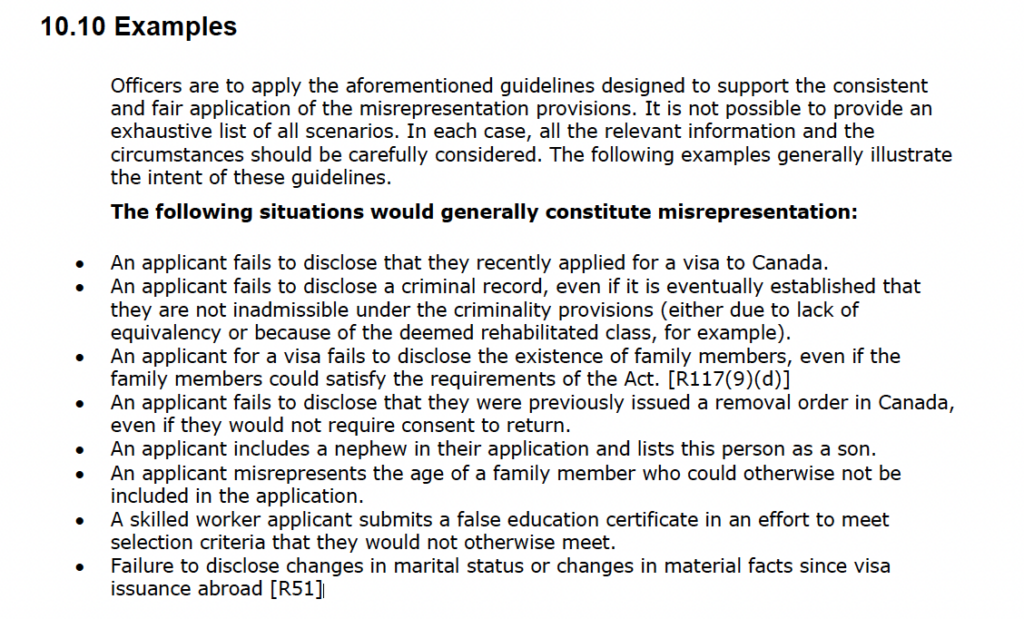
1. Failure to Disclose a Recent Canadian Visa Application
The first example concerns an applicant who fails to disclose that they recently applied for a visa to Canada.
Why can this matter?
An applicant’s previous Canadian immigration history can potentially be relevant to the assessment of a subsequent application.
For example, a previous application may contain information regarding employment, education, family circumstances, travel history, finances or the purpose of travel.
If a subsequent application provides different information, an officer may want to understand why.
The important lesson for applicants is simple:
Do not assume previous immigration history is irrelevant.
Where an application asks about previous applications or refusals, applicants should answer the question carefully and accurately.
A person should not assume that because an earlier application was unsuccessful, withdrawn, prepared by someone else or submitted many years ago, it can simply be ignored.
At the same time, whether a particular omission legally satisfies section 40 is ultimately a fact-specific legal question.
2. Failure to Disclose a Criminal Record
The historical guidance gives another particularly important example: failure to disclose a criminal record, even where it is ultimately determined that the person is not inadmissible under the criminality provisions.
This distinction can surprise applicants.
A person may think:
“If my old conviction does not ultimately make me criminally inadmissible to Canada, why would failing to disclose it matter?”
But those are potentially two different legal questions.
The historical guidance specifically contemplated situations where the underlying criminal history might ultimately not result in criminal inadmissibility—for example, because of equivalency considerations or rehabilitation—yet the failure to disclose that history could still raise a separate misrepresentation issue.
The practical lesson is extremely important.
Applicants should answer the questions actually asked in Canadian immigration forms rather than making their own determination about whether a fact is legally important.
If you are unsure whether an arrest, charge, conviction, discharge or other criminal-history issue needs to be disclosed, seek legal advice before submitting the application.
3. Failure to Disclose Family Members
The historical ENF 2/OP 18 guidance also identified failure to disclose the existence of family members as an example that would generally constitute misrepresentation.
Again, applicants should not make assumptions about whether a family member “counts.”
Depending upon the immigration program and the questions being asked, family information can be relevant even where a particular family member is not accompanying the applicant to Canada.
The historical guidance specifically contemplated that non-disclosure could be problematic even where those family members could otherwise satisfy the requirements of the legislation.
In other words, the issue may not simply be whether the family member would have created a substantive immigration problem.
The issue may also be whether material information was withheld from the immigration authorities.
This is why applicants should carefully review questions relating to spouses, common-law partners, children and other family relationships.
4. Failure to Disclose a Previous Removal Order
Another example given in section 10.10 concerned an applicant who fails to disclose that they had previously been issued a removal order in Canada.
Importantly, the historical guidance indicated that this could constitute misrepresentation even where the individual would not require consent to return.
This illustrates a broader principle.
An applicant should not decide that information can be omitted merely because they personally believe the underlying event no longer creates an immigration problem.
The obligation to provide truthful and complete information can be distinct from the ultimate legal consequences flowing from the disclosed event.
If an immigration form asks about a previous removal, deportation, exclusion or other immigration enforcement history, applicants should answer carefully.
Where there is uncertainty about the legal characterization of an old immigration event, obtaining the historical immigration records and receiving legal advice may be appropriate.
5. Listing a Nephew as a Son
The historical operational manual provides a very straightforward example:
An applicant includes a nephew in an application but identifies that person as their son.
Family relationships can have significant consequences under Canadian immigration law.
A false description of a relationship can potentially affect eligibility, dependency, sponsorship, accompanying-family-member considerations and other aspects of an immigration application.
Applicants therefore need to be particularly careful about information concerning:
- biological relationships;
- adoption;
- guardianship;
- marriage;
- common-law relationships;
- dependent children; and
- accompanying and non-accompanying family members.
Where a family situation is complicated, applicants should not simply choose the description they believe will make the application easier.
The correct legal characterization may require professional advice.
6. Misrepresenting the Age of a Family Member
The next historical example involves an applicant who misrepresents the age of a family member who otherwise could not have been included in the application.
This example illustrates the concept of materiality particularly clearly.
If changing a person’s age potentially changes whether that person qualifies to be included in an immigration application, the inaccurate information may directly affect the immigration decision-making process.
Applicants should therefore ensure that identity documents and information concerning dates of birth are accurate and consistent.
Where discrepancies genuinely exist—for example, because of historical civil-registration problems or conflicting older documents—the answer should not be to conceal the discrepancy.
It may be necessary to explain it and provide supporting evidence.
7. Submitting a False Educational Certificate
One of the clearest examples in the historical guidance concerns a skilled-worker applicant submitting a false educational certificate in an attempt to satisfy selection criteria that the applicant would not otherwise meet.
Educational credentials can be fundamental to immigration eligibility and selection.
False degrees, diplomas, transcripts, certificates or other educational records can therefore create very serious immigration consequences.
This issue has become particularly important in situations involving applicants who relied upon third parties or representatives to prepare their applications.
IRCC’s public position is that applicants remain responsible for the information in their applications, and the government has noted that Federal Court jurisprudence recognizes only a narrow innocent-mistake exception in extraordinary circumstances.
Therefore:
Never knowingly submit a document that is false, altered or misleading.
Applicants should also review documents prepared or obtained by representatives before they are submitted to IRCC.
The statement “my agent submitted it” should never be assumed to provide an automatic defence to a misrepresentation allegation.
8. Failure to Disclose Changes in Marital Status or Other Material Facts
The final example shown in section 10.10 concerns failure to disclose .
This is particularly important because applicants sometimes believe their obligation to provide updated information ends as soon as a visa is issued.
That assumption can be dangerous.
Material circumstances may change between:
application → approval → visa issuance → travel → examination at the Canadian port of entry.
Marriage is an obvious example.
Other changes may also potentially be relevant depending upon the immigration category and circumstances.
If a significant change occurs while an immigration process is ongoing—or after approval but before becoming a permanent resident or entering Canada—legal advice should be obtained about whether and how the change must be reported.
These Examples Are Not an Exhaustive List
Perhaps the most important part of section 10.10 is not any individual example.
It is the warning surrounding the examples.
The historical guidance made clear that an exhaustive list of every possible situation could not be provided and that officers should carefully consider all relevant information and circumstances in each case.
That principle is essential.
Two applications can contain apparently similar mistakes yet involve very different evidence and legal considerations.
For example, there may be a significant difference between:
deliberately creating a false document and making an error while completing a complicated form.
But even an innocent explanation does not automatically resolve the legal question.
The Federal Court jurisprudence surrounding misrepresentation is substantial and continues to develop. IRCC itself has publicly acknowledged that the “innocent mistake” exception recognized by the courts is narrow and depends on the particular circumstances.
That is precisely why applicants should avoid attempting to diagnose their own case from one example in an old operational manual.
“My Consultant or Agent Made the Mistake” — Is That Enough?
This is another area where applicants should exercise considerable caution.
IRCC currently tells applicants that they are responsible for the information contained in their immigration applications and warns that providing false information can result in refusal and other serious consequences.
The government has also summarized Federal Court jurisprudence as recognizing that a person may potentially be found inadmissible even where fraudulent information was supplied by their representative, subject to the narrow jurisprudential exception for innocent mistakes in appropriate circumstances.
Therefore, applicants should carefully review an application before submission.
Do not sign forms blindly.
Do not permit someone to invent employment, alter financial information, hide previous refusals or manufacture educational records because they say it will “improve” the application.
And if you discover a problem after submission, obtaining legal advice before attempting to correct or explain it can be extremely important.
What If IRCC Sends You a Procedural Fairness Letter for Misrepresentation?
A Procedural Fairness Letter (PFL) alleging possible misrepresentation should be taken extremely seriously.
This is not simply an ordinary request for another document.
Depending upon its wording, IRCC may be considering a finding under section 40 with consequences extending far beyond the refusal of the application currently under consideration.
A response should therefore address the specific concerns raised by the officer and the evidence relevant to those concerns.
Depending on the facts, legal counsel may need to examine:
- the application and forms originally submitted;
- supporting documents;
- previous Canadian applications;
- GCMS records;
- correspondence with IRCC;
- documents supplied by an agent or representative;
- the alleged inconsistency or omission;
- the materiality of the information;
- the applicant’s explanation;
- procedural fairness;
- applicable statutory provisions; and
- relevant Federal Court jurisprudence.
Simply writing, “It was an innocent mistake” does not necessarily answer the legal issue.
Similarly, simply blaming a representative without supporting evidence may not resolve the officer’s concerns.
Why a Five-Year Misrepresentation Finding Is Different From an Ordinary Refusal
An ordinary visa refusal is serious.
A section 40 inadmissibility finding can be much more consequential.
IRCC’s current public information warns that false information can result in refusal and potentially being prohibited from entering Canada for at least five years, as well as other consequences depending on the person’s circumstances.
Current enforcement guidance likewise recognizes a five-year exclusion period where an exclusion order results from section 40 misrepresentation.
That is why a potential misrepresentation allegation should not be treated as just another refusal reason.
The consequences can affect future Canadian immigration plans.
Every Section 40 Case Is Fact-Specific
This is the central message Fateh Law Corporation wants readers to take from this article.
There is no universal answer to a misrepresentation case.
A social-media post, an old operational manual, another applicant’s successful court case or an online discussion cannot tell you conclusively whether section 40 applies to your particular facts.
The historical ENF 2/OP 18 examples are useful educational material because they help demonstrate how immigration authorities have approached certain situations.
They are not a checklist that automatically determines the outcome of a present-day case.
Canadian immigration law evolves through legislation, regulations, operational policies and, importantly, decisions of the Federal Court and appellate courts.
The facts and evidentiary record of the individual case remain critical.
Facing a Misrepresentation Allegation or Five-Year Ban?
If IRCC has raised concerns that you:
failed to disclose a previous refusal, failed to disclose family information, failed to disclose criminal history, provided inaccurate documents, submitted incorrect educational information, failed to disclose a change in marital status, provided information through an agent that IRCC considers false, or otherwise withheld information, obtaining individualized legal advice is important.
Fateh Law Corporation practices Canadian immigration law and represents clients in immigration litigation, including matters proceeding before the Federal Court of Canada.
Where a section 40 finding has already been made, the appropriate legal options depend upon the type of decision, where and how it was made, the reasons given by the decision-maker and the individual circumstances of the case.
There is no substitute for reviewing the actual record.
Final Takeaway: Disclosure, Accuracy and Context Matter
The examples contained in the historical ENF 2/OP 18, section 10.10 provide a useful educational window into the kinds of circumstances immigration authorities have considered capable of amounting to misrepresentation.
They include failures to disclose previous Canadian visa applications, criminal records, family members and previous removal orders, as well as false information about family relationships or age, false educational credentials and failures to disclose changes in marital status or other material circumstances.
But the most important message in the guidance is equally important:
The examples are not exhaustive, and the relevant information and circumstances of the individual case must be considered.
A five-year inadmissibility finding can have profound consequences for an applicant and their family.
If you have received a Procedural Fairness Letter, a refusal containing a section 40 misrepresentation finding, or believe incorrect information may have been submitted in your immigration application, consider obtaining legal advice promptly rather than relying on generalized information online.
Educational & Legal Disclaimer
This article is published by Fateh Law Corporation for general educational and informational purposes only. It does not constitute legal advice and does not create a solicitor-client relationship.
The ENF 2/OP 18 material discussed above is historical operational guidance, including material dated August 1, 2015. It should not be relied upon as a complete or necessarily current statement of IRCC policy or Canadian immigration law.
The examples discussed are illustrative and non-exhaustive. Misrepresentation cases are highly fact-specific, and the applicable law and jurisprudence must be considered in light of the particular facts and evidence.
If you are facing an allegation of misrepresentation, a Procedural Fairness Letter, a five-year inadmissibility finding or a related refusal, seek individualized advice from a qualified Canadian immigration lawyer.