


There are moments in a lawyer’s career that are professionally significant, and there are moments that are significant for the profession itself.
Being given the opportunity to argue before the Federal Court of Canada is one of the privileges of practising federal litigation. But when an actual Federal Court proceeding is brought into a law school environment, allowing future lawyers to observe the court process in person, the significance goes beyond the individual case.
It becomes an opportunity for legal education, professional development and the transmission of practical advocacy skills from one generation of lawyers to the next.
Fateh Law Corporation and Mr. Navratan Singh Fateh are deeply honoured and humbled by the opportunity to have upcoming Federal Court immigration judicial review hearings take place in person at the Peter A. Allard School of Law at the University of British Columbia in Vancouver.

The two hearings are scheduled for:
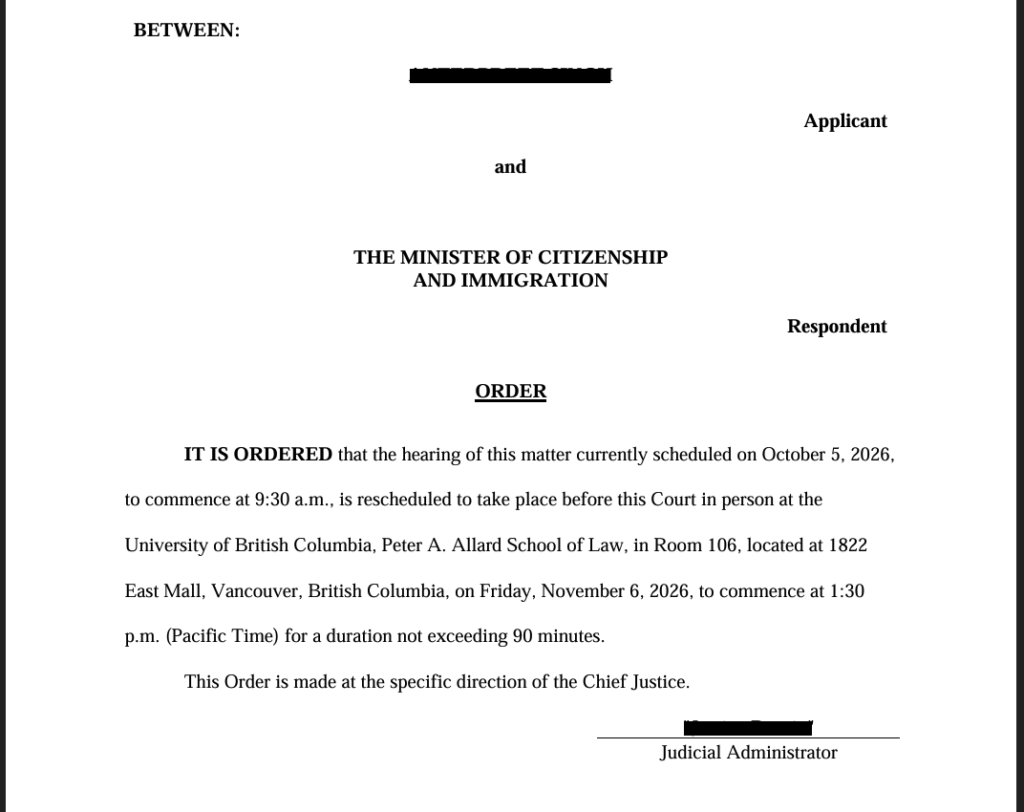
- Friday, November 6, 2026, at 1:30 p.m. Pacific Time, for a duration not exceeding 90 minutes; and
- Monday, November 16, 2026, at 3:30 p.m. Pacific Time, for a duration not exceeding 90 minutes.
The orders provided to us have been redacted and are reproduced or referred to for informational purposes only. The orders state that the hearings are to take place before the Federal Court in person at the University of British Columbia, Peter A. Allard School of Law, Room 106, 1822 East Mall, Vancouver, British Columbia, and that the orders were made at the specific direction of the Chief Justice.
This is an important opportunity not simply for our firm, but for students who may one day become advocates before the Federal Court themselves.
A courtroom is one of the greatest classrooms for a future lawyer
Law school teaches students the law.
It teaches statutes, regulations, constitutional principles, administrative law, evidence, procedure, advocacy and legal writing.
But there is another kind of learning that is difficult to acquire entirely from textbooks.
That is the experience of watching law being argued and applied in a real courtroom.
A student can read a judicial review decision.
A student can study the Federal Courts Act.
A student can read cases discussing procedural fairness, reasonableness, jurisdiction, statutory interpretation and the appropriate role of a reviewing court.
A student can learn the structure of a Federal Court application from a practice guide.
But watching an experienced lawyer stand before a judge and answer difficult questions is different.
It demonstrates something that cannot always be captured on a page:
What does advocacy actually look like?
How does counsel respond when the judge asks a question that was not anticipated?
How does counsel distinguish an unfavourable authority?
How does counsel explain why a decision-maker’s reasoning is unreasonable?
How does counsel respond when the Court appears to disagree with an important submission?
How does counsel decide which arguments are worth pursuing and which arguments should be abandoned?
How does counsel maintain credibility?
How does counsel respectfully disagree with the Court?
How does counsel listen?
How does counsel manage time?
How does counsel move from written submissions to concise oral advocacy?
These are skills that are developed through experience.
And experience is one of the things that the legal profession must actively pass from one generation to another.
Why Federal Court judicial review matters
The Federal Court occupies a unique position in Canada’s legal system.
The Federal Court is Canada’s national trial court and hears legal disputes arising within the federal domain. Its judges travel throughout Canada to hear matters within the Court’s jurisdiction.
For immigration lawyers, the Court is particularly important.
Canadian immigration decisions can profoundly affect people’s lives.
A refusal of a permanent residence application can separate spouses.
A refusal of a temporary resident visa can prevent parents from visiting their children.
A refusal of a study permit can affect a student’s education.
A finding of inadmissibility can have enormous consequences for a family.
A refusal of a refugee-related application can involve questions of safety and protection.
A procedural fairness issue can affect whether an applicant had a meaningful opportunity to respond to concerns raised by an immigration decision-maker.
In these circumstances, judicial review provides an important legal mechanism through which the legality of federal administrative decisions can be scrutinized.
Section 18.1 of the Federal Courts Act provides for judicial review of decisions and allows the Federal Court, where the statutory requirements are met, to grant remedies including setting aside a decision and referring the matter back for determination. The provision also identifies grounds including jurisdictional error, procedural unfairness, errors of law, certain erroneous findings of fact and other conduct contrary to law.
This is not an appeal in the traditional sense.
That distinction is fundamental.
A lawyer practising immigration judicial review must understand the difference between saying:
“The decision-maker got the answer wrong.”
and saying:
“The decision-making process or reasoning was legally unreasonable or otherwise unlawful in a manner that warrants judicial intervention.”
That distinction is one of the foundations of Federal Court immigration practice.
Judicial review is not simply another immigration application
One of the most important things a future immigration lawyer can learn is that Federal Court litigation is a different form of legal practice from immigration application work.
An immigration application generally asks the government to grant something.
A judicial review proceeding asks a court to review the legality of a decision already made by a federal decision-maker.
The lawyer must therefore shift from an application mindset to a litigation mindset.
The question becomes:
What did the decision-maker do, what was the legal framework, what was the reasoning, and is there a reviewable error?
The Federal Court’s own materials explain that it has jurisdiction to review the legality of actions of many federal offices, boards, commissions and tribunals, including matters involving citizenship, immigration and refugee protection.
That is why observing an actual judicial review hearing can be so valuable to a law student.
It allows the student to see administrative law move from theory to practice.
The importance of learning judicial review advocacy early
Many law students encounter administrative law during their studies.
They learn the cases.
They learn standards of review.
They learn procedural fairness.
They learn statutory interpretation.
They learn the relationship between administrative decision-makers and reviewing courts.
But there is a significant difference between understanding a legal principle academically and understanding how that principle is deployed in an actual hearing.
For example, a student may understand that a reviewing court does not simply substitute its own decision for that of an administrative decision-maker.
But watching counsel make submissions makes the principle practical.
The student begins to appreciate questions such as:
- What exactly is the alleged reviewable error?
- Where in the decision does that error appear?
- What was the decision-maker required to consider?
- What did the decision-maker actually consider?
- What evidence was before the decision-maker?
- What does the record establish?
- What legal test applies?
- What authorities support the submission?
- What authorities appear to undermine it?
- How should those authorities be distinguished?
- What remedy is being sought?
- What should happen if judicial review is granted?
These are not merely academic questions.
They are questions that arise in real litigation.
Learning by observing the Court
The Federal Court itself recognizes the educational value of observing hearings.
Its public guidance explains that, except in very rare circumstances, hearings are open to the public and that individuals may observe another hearing to gain a better understanding of how hearings are conducted.
That principle is particularly meaningful for law students.
A student sitting in a courtroom has an opportunity to observe things that may never appear in a reported judgment.
A written judgment tells us what happened from the perspective necessary to decide the case.
A live hearing demonstrates the process.
The student can observe:
The relationship between counsel and the Court
Advocacy is not simply speaking.
It is a conversation with the Court.
The lawyer must listen carefully to the judge’s questions and understand what the question is actually asking.
Sometimes a judge’s question may expose a weakness in an argument.
Sometimes it may give counsel an opportunity to clarify a point.
Sometimes the question may indicate that the Court wants counsel to address an authority or factual issue that has become important.
A future lawyer who watches experienced counsel respond to those questions can learn an enormous amount about professional judgment.
The importance of oral advocacy
Written advocacy is essential in Federal Court litigation.
But oral advocacy is different.
The lawyer has limited time.
The judge may interrupt.
The Court may have read the materials carefully and may already understand the basic facts.
Consequently, oral advocacy is not simply reading the memorandum aloud.
It requires judgment.
A good advocate must identify what matters most.
The lawyer must know the record.
The lawyer must know the authorities.
The lawyer must understand the opposing position.
And, perhaps most importantly, the lawyer must know the case well enough to adapt.
This is something students can learn by observation.
A law student can learn from questions just as much as answers
One of the most valuable aspects of observing a judicial review hearing is listening to the questions from the bench.
A question from a judge can reveal what the Court considers important.
It can expose a missing step in counsel’s reasoning.
It can force counsel to confront an adverse authority.
It can require counsel to explain why a particular fact matters.
It can also demonstrate that litigation is not about delivering a predetermined speech.
The lawyer must be prepared for the case to develop differently from the way it was imagined in the office.
That is advocacy.
And it is extremely difficult to learn that solely from a textbook.
Immigration law and Federal Court litigation
Immigration law is one of the most significant areas of Federal Court practice.
The Court’s published statistics demonstrate the scale of immigration and refugee matters before the Federal Court. As of June 30, 2026, the Court reported 28,366 Immigration and Refugee matters, representing 83.5% of the Court’s reported caseload for the relevant period.
That reality creates a tremendous need for lawyers who understand not only immigration law but also immigration litigation.
There is a difference between knowing the Immigration and Refugee Protection Act and knowing how to litigate an immigration decision before the Federal Court.
There is a difference between preparing an immigration application and preparing a judicial review application.
There is a difference between writing an explanation letter to IRCC and writing legal submissions to a reviewing court.
There is a difference between persuading an administrative decision-maker and persuading a judge that a decision should be set aside.
Future lawyers need opportunities to understand those differences.
The Federal Court’s role in immigration justice
Judicial review serves an important constitutional and administrative-law function.
Federal decision-makers exercise significant statutory powers.
But those powers are exercised within a legal framework.
The Federal Court’s role is not to administer Canada’s immigration system.
The Court’s role is to determine whether the decision under review is lawful according to the applicable legal principles.
That distinction is fundamental to understanding administrative law.
A future immigration lawyer should appreciate both sides of the equation.
The lawyer must understand the expertise and statutory authority of administrative decision-makers.
At the same time, the lawyer must understand that administrative decision-making remains subject to legal constraints.
This balance is at the heart of judicial review.
What students can learn from a real immigration judicial review
A law student attending one of these hearings can potentially observe an entire range of advocacy skills.
1. How counsel introduces a case
The opening moments matter.
A lawyer must orient the Court.
What is the issue?
What relief is being sought?
What is the essential legal problem?
Why does the Court have jurisdiction?
A concise and organized opening can make a complicated case easier to understand.
2. How counsel identifies the real issue
Immigration cases can involve enormous factual histories.
There may be applications, refusals, correspondence, procedural fairness letters, supporting documents, affidavits and extensive records.
But the Federal Court hearing cannot become a re-hearing of every fact.
The advocate must identify the legal issue that matters.
That is a skill.
3. How counsel uses the record
Judicial review is fundamentally record-based litigation.
A lawyer cannot simply introduce an entirely new case at the hearing.
The advocate must know what evidence was before the decision-maker and understand how the decision-maker dealt with that evidence.
A student watching counsel work through the record can begin to understand the discipline required in judicial review practice.
4. How counsel uses authorities
A good lawyer does not cite cases simply to demonstrate that research was completed.
Authorities must have a purpose.
The lawyer should know:
- What proposition does the case establish?
- Is the case binding?
- Is it persuasive?
- Are the facts comparable?
- Has later jurisprudence affected it?
- How does it apply to the present case?
Watching lawyers use authorities orally can teach students how legal research becomes legal advocacy.
The difference between reading a judgment and watching a case
A judgment is the product of a legal proceeding.
A hearing is the process that leads to that result.
Both are educational.
But they teach different things.
A judgment can teach:
- the legal principles;
- the factual background;
- the issues;
- the Court’s analysis;
- the result;
- the remedy.
A hearing can additionally teach:
- courtroom etiquette;
- timing;
- questioning;
- advocacy;
- professional tone;
- responsiveness;
- organization;
- judicial interaction;
- strategic decision-making;
- professional judgment.
That is why opportunities to observe real hearings are so valuable.
The significance of bringing Federal Court hearings to a law school
The decision reflected in the orders provided to us is particularly meaningful because the hearings are scheduled to take place at the Peter A. Allard School of Law at the University of British Columbia.

The setting itself creates a bridge between legal education and legal practice.
Students do not have to imagine what Federal Court litigation looks like.
They can see it.
They can hear it.
They can observe lawyers presenting arguments.
They can observe the Court.
They can see how legal principles studied in class are applied to real disputes.
And they can begin to imagine themselves participating in the profession.
This is one of the most powerful aspects of experiential legal education.
A special opportunity for future immigration lawyers
Canadian immigration law is constantly evolving.
The legislation changes.
Regulations change.
Ministerial instructions change.
Government policies change.
Administrative practices change.
Jurisprudence develops.
The volume and complexity of immigration litigation also continue to create demand for lawyers who understand administrative law and Federal Court procedure.
The next generation of immigration lawyers therefore needs more than an understanding of immigration forms and application processes.
They need to understand litigation.
They need to know what happens when an immigration decision is challenged.
They need to understand the role of the Federal Court.
They need to understand the record.
They need to understand judicial review.
They need to understand procedural fairness.
They need to understand remedies.
And they need to develop the advocacy skills necessary to present these issues effectively.
Why practical mentorship matters
Every profession has a responsibility to educate the people who will follow it.
Law is no different.
Experienced lawyers have benefited from teachers, mentors, colleagues, judges, opposing counsel and professional institutions.
The profession survives because knowledge is transmitted.
A lawyer does not enter a courtroom fully formed.
Advocacy is developed over years.
It develops through preparation.
It develops through observation.
It develops through mistakes.
It develops through feedback.
It develops through watching other advocates.
And it develops through the privilege of appearing before experienced judges.
That is why opportunities for law students to observe real proceedings are so important.
Mr. Fateh’s journey into litigation
For Mr. Navratan Singh Fateh, this opportunity also represents another stage in a professional journey that began with his call to the bar in 2014.
Mr. Fateh has now accumulated over 12 years of litigation experience as a Canadian lawyer.
That experience has included advocacy involving Canadian immigration law and litigation before the Federal Court and Immigration Appeal Division.
The opportunity to bring that experience into an educational setting is therefore particularly meaningful.
The objective is not simply to say that a lawyer has appeared before a court.
The more important question is:
What can the next generation learn from that experience?
Experience has value when it is shared.
Knowledge becomes more valuable when it is passed forward.
And legal education becomes stronger when students can connect classroom theory with actual legal practice.
The responsibility of experienced lawyers
Experienced lawyers have a responsibility beyond their individual clients.
That does not mean compromising client confidentiality or the duties owed to clients and the Court.
It means recognizing that the legal profession is larger than any one lawyer.
Every lawyer is temporarily a custodian of professional knowledge.
Eventually, the lawyer who is learning today may become the mentor of tomorrow.
The law student watching a Federal Court hearing today could become a Federal Court advocate ten years from now.
That student could eventually mentor another student.
And that is how professional knowledge continues.
“True learning” requires transmission between generations
There is a simple truth about professional education:
Some things can only be learned properly by seeing them done.
A medical student learns from observing physicians.
An engineering student learns by applying engineering principles.
An apprentice learns by working alongside someone experienced.
And a future litigator learns by watching litigation.
Books are indispensable.
Legal databases are indispensable.
Case law is indispensable.
University education is indispensable.
But none of these replaces the experience of observing advocacy in real time.
The future of the legal profession depends upon combining all of them.
Why judicial review should attract more young lawyers
Judicial review is one of the most intellectually challenging areas of legal practice.
It combines:
- administrative law;
- statutory interpretation;
- constitutional principles;
- procedural fairness;
- evidence;
- legal research;
- written advocacy;
- oral advocacy;
- remedies;
- litigation strategy.
For an immigration lawyer, judicial review can also involve enormous human consequences.
Behind a legal file is often a person.
Behind a refusal may be a family.
Behind a procedural fairness issue may be a student.
Behind a delay may be a spouse waiting to reunite with a partner.
Behind a residency issue may be a permanent resident trying to preserve their status in Canada.
The lawyer must therefore combine technical legal skill with an understanding of the human consequences of administrative decision-making.
Judicial review is about legality, not simply disappointment
One of the most important lessons future immigration lawyers should take from Federal Court practice is that not every disappointing immigration decision is necessarily a judicial review case.
A refusal does not automatically establish an error of law.
A lawyer must identify a legally reviewable problem.
That may involve, depending on the circumstances:
- procedural fairness;
- unreasonable reasoning;
- failure to consider material evidence;
- misunderstanding evidence;
- legal error;
- jurisdictional issues;
- unreasonable factual findings;
- failure to follow applicable legal requirements.
The Federal Courts Act provides the statutory framework for judicial review, while the jurisprudence provides the interpretive framework lawyers must apply to individual cases.
This is exactly the kind of distinction that becomes clearer when a student watches a real judicial review hearing.
Understanding what Federal Court judicial review is — and is not
A strong Federal Court advocate understands the limits of the proceeding.
The Federal Court is not simply replacing the immigration officer’s decision with the lawyer’s preferred decision.
The Court reviews the legality of the decision-making process and decision according to the applicable law.
Where judicial review is allowed, the remedy can include setting aside the decision and sending the matter back for reconsideration.
The Federal Court’s immigration judicial review guidance explains that when judicial review is granted, the matter may be referred back to the decision-maker for reconsideration.
This is an important lesson for law students.
The objective of judicial review advocacy is not simply to tell the judge:
“My client deserves a visa.”
The advocate must explain:
“Here is the legal error that occurred, here is where it appears in the record, here is why the error matters, and here is the remedy the Court can properly grant.”
That distinction is the foundation of competent judicial review advocacy.
The importance of preparation
What students see in a 90-minute hearing represents many hours of preparation.
The hearing itself is only the visible portion of litigation.
Behind the scenes, counsel must understand the record.
They must identify the issues.
They must research the law.
They must prepare written submissions.
They must anticipate the respondent’s position.
They must identify potentially difficult questions.
They must prepare answers.
They must understand the remedies available.
They must understand procedural requirements and deadlines.
The Federal Court publishes procedural guidance setting out the stages involved in judicial review proceedings, including filing requirements, records, memoranda and hearing procedures.
Students observing a hearing should therefore appreciate that the advocacy they see is the culmination of extensive preparation.
Written advocacy and oral advocacy must work together
One of the most important lessons in litigation is that written and oral advocacy are connected.
The written record provides the foundation.
The oral hearing provides an opportunity to clarify and emphasize.
A lawyer should not assume that every argument written in a memorandum needs to be repeated orally.
Instead, oral advocacy should help the Court focus on the issues that genuinely require attention.
That requires judgment.
A young lawyer watching an experienced advocate can learn this distinction.
The value of being questioned by a judge
For many law students, one of the most interesting aspects of a Federal Court hearing may be seeing how counsel responds to judicial questions.
A judge may ask:
“Where exactly is that in the record?”
A future lawyer needs to know.
A judge may ask:
“What is your authority for that proposition?”
A future lawyer needs to know.
A judge may ask:
“Isn’t this essentially an invitation for the Court to reweigh the evidence?”
The lawyer must have an answer.
A judge may identify an authority that appears to contradict counsel’s position.
The advocate must be prepared.
These moments are educational because they demonstrate the difference between knowing the law and being able to argue the law under pressure.
Professionalism is part of advocacy
Another lesson that cannot easily be taught through textbooks is professional conduct.
Courtroom advocacy should be firm without being disrespectful.
Counsel can disagree without being discourteous.
A lawyer can strongly defend a client’s interests while maintaining respect for the Court and opposing counsel.
Students watching a hearing can see that professionalism is not an abstract concept.
It is demonstrated through:
- tone;
- language;
- preparation;
- honesty;
- courtesy;
- accuracy;
- punctuality;
- respect;
- candour;
- responsibility.
These qualities form the foundation of a strong legal profession.
The importance of observing immigration litigation specifically
Students interested in litigation often have opportunities to observe criminal, civil or commercial proceedings.
Immigration judicial review provides a different perspective.
It sits at the intersection of:
administrative law + public law + human consequences + federal jurisdiction.
A single immigration judicial review can require counsel to understand a highly specialized statutory regime while simultaneously applying broad administrative-law principles.
That combination makes immigration litigation an intellectually demanding field.
It also makes it an area in which future lawyers can build highly specialized expertise.
A profession needs specialists
The legal profession benefits when lawyers develop genuine expertise.
Immigration law is sufficiently complex that lawyers who want to practise at the Federal Court level must understand more than immigration policy.
They need to understand litigation.
They need to understand the Federal Court Rules and applicable practice requirements.
They need to understand judicial review jurisprudence.
They need to understand how immigration decisions are made.
They need to understand the administrative record.
They need to understand the limitations of the record.
They need to understand remedies.
They need to understand advocacy.
And they need to develop the professional judgment necessary to decide when litigation is appropriate.
Training future lawyers in these skills benefits not only the lawyers themselves but also future clients and the administration of justice.
Why law students should attend in person
For students at UBC’s Peter A. Allard School of Law, these hearings represent an opportunity to observe Federal Court proceedings without having to wait until they begin practising.
There is enormous value in being physically present.
Students can see the courtroom environment.
They can observe the interaction between the bench and counsel.
They can hear the pace and tone of oral submissions.
They can see how lawyers organize their materials.
They can observe how questions are handled.
They can see how legal arguments are presented in practice.
And perhaps most importantly, they can begin to picture themselves doing the same work.
From student to advocate
Every experienced lawyer was once a student.
At some point, every advocate sat in a classroom wondering what litigation would actually feel like.
Every lawyer who has appeared before a judge had a first hearing.
Every experienced counsel once had to learn how to respond to difficult questions.
The transition from student to lawyer does not happen overnight.
It occurs through hundreds of small experiences.
A lecture.
A case.
A moot.
A summer position.
A conversation with a lawyer.
A court observation.
A first appearance.
A difficult hearing.
A mentor’s advice.
Over time, these experiences build professional judgment.
That is why initiatives that bring students closer to actual court proceedings matter.
The Federal Court and access to justice
There is also a broader public dimension.
The Federal Court describes its role as providing access to justice across Canada, with judges travelling throughout the country to hear matters within the Court’s national jurisdiction.
Access to justice is not only about whether a litigant can physically enter a courtroom.
It is also about whether there are lawyers who understand how to use the legal system effectively.
That means the legal profession must continually train new advocates.
If future lawyers do not understand Federal Court litigation, access to justice becomes more difficult.
If more lawyers understand judicial review, administrative law and Federal Court procedure, clients have a greater opportunity to find competent representation when they need it.
Training future lawyers is therefore indirectly connected to access to justice.
The significance of the Chief Justice’s direction
The orders provided to us contain particularly meaningful language.
They state that the hearings are being rescheduled to take place in person at the University of British Columbia, Peter A. Allard School of Law, and expressly state:
“This Order is made at the specific direction of the Chief Justice.”
That is a significant aspect of the opportunity.
It demonstrates a deliberate connection between the Court and legal education.
The orders provided to us have been redacted, and the redacted versions are being referred to for informational purposes only.
We do not reproduce confidential or identifying information that has been redacted from the documents.
The focus of this discussion is therefore not on the identity of the parties or the confidential details of the underlying litigation.
The focus is on the broader educational significance of having Federal Court proceedings take place in a law-school environment.
A special responsibility for lawyers in immigration litigation
Immigration lawyers occupy an unusual position.
Their work can affect whether families live together.
It can affect whether students can study.
It can affect whether workers can build careers.
It can affect whether permanent residents can maintain status.
It can affect whether individuals can remain connected to Canada.
Because of those consequences, the profession needs lawyers who take advocacy seriously.
That means understanding the law.
It means understanding procedure.
It means knowing the record.
It means being prepared.
It means being candid with the Court.
It means knowing the limits of an argument.
And it means continuously learning.
The next generation must be better prepared than the current generation
A profession should not simply reproduce itself.
It should improve.
The next generation of lawyers should have access to better training, better resources and better opportunities than the generation before them.
That requires experienced practitioners to open the door.
It requires judges and courts to engage with legal education.
It requires law schools to create opportunities for practical learning.
And it requires students to take advantage of those opportunities.
The purpose should not be to create lawyers who merely know more.
It should be to create lawyers who think better, advocate better and serve their clients and the justice system better.
Learning from the Court is a privilege
For us at Fateh Law Corporation, being involved in these hearings is a privilege.
We recognize that the courtroom is not a stage.
It is a place where legal disputes are resolved.
Counsel’s first responsibility is to the client within the bounds of professional obligations and the administration of justice.
The educational opportunity comes from allowing students to observe that process.
We are deeply conscious of the responsibility that accompanies such an opportunity.
Mr. Fateh’s 12 years of litigation experience
Mr. Fateh was called to the Canadian bar in 2014.
With more than 12 years of litigation experience, he has spent a substantial portion of his legal career working within Canadian immigration law and litigation.
For an experienced litigator, one of the most rewarding aspects of practice is eventually being able to share what has been learned.
Every appearance teaches something.
Every difficult case teaches something.
Every question from the bench teaches something.
Every successful argument teaches something.
Every unsuccessful argument can teach something even more valuable.
The profession grows when those lessons are passed on.
Why this is bigger than one law firm
It would be easy to view these hearings simply as another professional milestone for Fateh Law Corporation.
We see them differently.
The larger significance is the opportunity to contribute, even in a small way, to the education of future lawyers.
The legal profession belongs to everyone who participates in it.
Today’s law students will become tomorrow’s:
- advocates;
- judges;
- government lawyers;
- academics;
- legal policymakers;
- professors;
- legal aid lawyers;
- private practitioners;
- community advocates.
Some will practise immigration law.
Some will practise administrative law.
Some will never appear before the Federal Court.
But all can benefit from seeing how litigation actually works.
The importance of encouraging young lawyers to practise immigration law
Canadian immigration law needs lawyers who are willing to develop deep expertise.
It is a demanding area of practice.
The legislation and policies are complex.
The consequences of decisions can be enormous.
The volume of Federal Court immigration litigation is substantial.
The Federal Court’s statistics illustrate the importance of immigration and refugee matters within its overall workload.
Future lawyers should therefore understand that immigration law is not simply an administrative practice involving forms and applications.
At the higher levels of practice, it can involve sophisticated litigation.
It can involve statutory interpretation.
It can involve administrative law.
It can involve procedural fairness.
It can involve constitutional considerations.
It can involve detailed legal research and complex advocacy.
There is an enormous opportunity for young lawyers who want to specialize.
Federal Court advocacy requires intellectual discipline
A strong Federal Court advocate must be disciplined.
The lawyer must resist the temptation to argue every possible point.
More arguments do not necessarily mean a stronger case.
Sometimes the strongest case is built around one or two clearly identifiable legal errors.
The lawyer must ask:
What is the actual reviewable error?
Then:
Can I demonstrate it from the record?
Then:
What does the jurisprudence say?
Then:
What remedy should follow?
That discipline is one of the things future lawyers can learn from observing experienced counsel.
The importance of understanding the limits of judicial review
The Federal Court’s role is carefully defined.
The Court’s jurisdiction and remedial powers arise within the statutory framework.
Section 18.1 of the Federal Courts Act provides the statutory basis for judicial review and identifies circumstances in which relief may be granted.
A future lawyer therefore needs to understand not only how to identify an error but also the limits of the Court’s intervention.
That understanding is essential to responsible advocacy.
A lawyer should not promise a client that a court will approve an immigration application.
The lawyer should instead explain what judicial review can and cannot accomplish.
If the Court grants judicial review, the matter may be sent back for reconsideration.
That does not necessarily mean the applicant automatically receives the underlying immigration benefit.
The distinction is fundamental.
The role of humility in litigation
One of the greatest lessons experienced lawyers can pass to younger lawyers is the importance of humility.
Litigation can be adversarial.
Lawyers can become passionate about their cases.
Clients understandably want their lawyers to fight hard.
But effective advocacy requires discipline.
The lawyer must remain open to the possibility that the Court may see something differently.
The lawyer must be prepared to answer difficult questions honestly.
The lawyer must recognize the Court’s role.
And the lawyer must never confuse confidence with certainty.
The best advocates are often the lawyers who can remain calm, respectful and analytical even when the hearing becomes difficult.
The courtroom as a place of professional learning
There is an important cultural aspect to court observation.
When students sit in a courtroom, they are not merely watching lawyers argue.
They are learning what professional conduct looks like.
They are seeing how lawyers interact with judges.
They are seeing how opposing counsel interact.
They are seeing how disagreements are managed.
They are seeing how legal arguments are structured.
They are seeing how the justice system functions.
Those observations become part of their understanding of what it means to be a lawyer.
Why this matters at a law school
A university law school is a natural environment for this kind of initiative.
Students spend years studying law.
They learn the theory.
They learn the history.
They learn doctrine.
They participate in mooting and advocacy exercises.
But there is a point where education needs to connect with practice.
Bringing an actual Federal Court proceeding into the law-school environment creates that connection.
It allows students to see that the cases they read are not merely abstract legal problems.
They are disputes involving real people, real government decisions and real legal consequences.
The opportunity for students at Allard Law
For students at the Peter A. Allard School of Law, we strongly encourage taking advantage of this opportunity.
If you are interested in:
- administrative law;
- immigration law;
- public law;
- constitutional law;
- litigation;
- judicial review;
- appellate advocacy;
- access to justice;
- government decision-making;
A Federal Court judicial review hearing can be an extremely valuable educational experience.
Students should observe not only the outcome but the process.
Watch how counsel presents the case.
Listen to the questions.
Notice how counsel answers.
Observe how legal authorities are used.
Pay attention to how the issues are narrowed.
Watch the interaction between the Court and counsel.
These observations can become lessons that remain with a young lawyer for years.
The importance of asking questions after the hearing
The educational value of the experience can extend beyond the hearing itself.
A question-and-answer session with lawyers and the Federal Court judge, where available as part of the educational programming surrounding the event, can provide students with an additional opportunity to understand the profession.
Students may have questions such as:
- How do you prepare for a judicial review?
- What makes an effective oral argument?
- How should a young lawyer prepare for their first Federal Court appearance?
- How do judges approach difficult administrative-law issues?
- What makes counsel persuasive?
- How important is written advocacy?
- How should lawyers deal with adverse authorities?
- What mistakes should young advocates avoid?
- How does one develop expertise in immigration litigation?
These are questions that cannot always be answered effectively in a textbook.
They are questions best explored through conversation with people who actually practise in the field.
Building a culture of legal mentorship
The legal profession should encourage mentorship.
A young lawyer should not have to discover every lesson through trial and error.
Experienced lawyers should be willing to share knowledge.
Judges should be able to contribute to legal education while maintaining the independence and integrity of the judicial role.
Law schools should facilitate interaction between students and practitioners.
And students should actively seek opportunities to observe and learn.
That creates a professional culture where knowledge moves forward instead of disappearing when lawyers retire or leave practice.
The broader lesson: law is a profession, not simply a career
Being a lawyer is more than obtaining a licence to practise.
It is becoming part of a professional community with responsibilities.
Those responsibilities include serving clients.
They include duties to the Court.
They include maintaining professional competence.
They include continuing legal education.
And they include contributing to the development of the profession.
For experienced lawyers, that contribution can include mentoring future lawyers.
For courts, it can include supporting legal education and allowing appropriate public observation of proceedings.
For law schools, it can include bringing students into contact with the realities of legal practice.
And for students, it means taking the initiative to learn.
What the next generation can take away
If a student attends these hearings, we hope the experience demonstrates several important lessons.
First: Preparation matters.
Great oral advocacy begins long before the lawyer enters the courtroom.
Second: Know your record.
In judicial review, the record matters enormously.
Third: Know your law.
A lawyer must understand the governing statute and the jurisprudence.
Fourth: Listen to the judge.
A hearing is a dialogue, not a speech.
Fifth: Be concise.
The Court’s time is valuable.
Sixth: Be respectful.
Professionalism is never optional.
Seventh: Know the limits of your case.
Credibility is more important than exaggeration.
Eighth: Continue learning.
No lawyer ever reaches a point where there is nothing left to learn.
Ninth: Learn from other lawyers.
Observation is one of the greatest forms of professional education.
Tenth: Pass it forward.
Eventually, today’s student should become tomorrow’s mentor.
The future of Canadian immigration litigation
Canada’s immigration system will continue to evolve.
As it does, there will continue to be disputes over the interpretation and application of federal immigration legislation.
There will continue to be questions about procedural fairness.
There will continue to be challenges involving administrative decision-making.
There will continue to be judicial review applications.
And there will continue to be individuals and families who require lawyers capable of navigating those legal processes.
The future therefore requires lawyers who are comfortable with both immigration law and litigation.
The Federal Court’s current statistics demonstrate the scale of immigration-related proceedings before the Court, reinforcing why developing specialized litigation expertise is important for the profession.
A message to future lawyers
To the students who may attend these hearings, our message is simple:
Watch carefully.
Do not only watch who wins.
Watch how the lawyers prepare.
Watch how they answer questions.
Watch how they handle difficult moments.
Watch how they use authorities.
Watch how they address the Court.
Watch how they respond when challenged.
And ask yourself:
Could I do this one day?
If the answer is yes, then perhaps this experience will be the beginning of your own journey into litigation.
A message to future immigration lawyers
If you are considering immigration law, do not limit your understanding of the profession to applications.
Learn the litigation side.
Study administrative law.
Read Federal Court decisions.
Understand judicial review.
Learn the Federal Courts Rules.
Read written submissions.
Observe hearings.
Watch experienced counsel.
Learn how procedural fairness arguments are made.
Understand what the record means.
Learn about remedies.
Understand the difference between an appeal and judicial review.
And most importantly, learn how to advocate responsibly.
The clients of the future will need lawyers who can do more than complete forms.
They will need lawyers who can identify legal problems and, where appropriate, advocate for them before the courts.
Why we are humbled by this opportunity
For Fateh Law Corporation, this opportunity is deeply meaningful.
We are grateful to the Federal Court of Canada and to the Chief Justice for the opportunity reflected in these orders.
We are grateful to the Peter A. Allard School of Law for being the setting in which this learning opportunity can take place.
And we are grateful for the privilege of practising law in a system in which lawyers can appear before an independent judiciary to make legal submissions on behalf of their clients.
The honour is not simply in appearing before the Court.
The greater honour is being able to contribute, in however small a way, to the education of the lawyers who will follow us.
The profession belongs to the next generation
Every generation of lawyers eventually passes the responsibility of the profession to the next.
The question is what we leave behind.
Do we leave behind only case files and judgments?
Or do we leave behind knowledge?
Do we teach the next generation how to prepare?
Do we show them what advocacy looks like?
Do we encourage them to enter difficult areas of practice?
Do we encourage them to serve clients with integrity?
Do we encourage them to understand the justice system?
Do we give them opportunities to learn from real lawyers and real proceedings?
These questions matter.
Because the quality of tomorrow’s legal profession depends partly on the opportunities today’s lawyers create for tomorrow’s lawyers.
Learning does not end at law school
It is important to emphasize that this initiative is not about suggesting that a law student will become a Federal Court litigator simply by watching one hearing.
That is not the point.
The point is that professional development begins with exposure.
A student may watch a hearing and become interested in administrative law.
Another may decide to pursue immigration law.
Another may become interested in judicial review.
Another may decide that litigation is not for them.
All of those outcomes are valuable.
Education is about giving people enough exposure to make informed choices.
The importance of preserving professional knowledge
Legal knowledge is constantly evolving.
A lawyer who qualified years ago cannot assume that the law remains exactly as it was.
Similarly, a law student cannot rely solely on what is taught in a classroom.
Professional development requires continuous learning.
Judicial decisions develop.
Legislation changes.
Procedures change.
Practice directions change.
The Federal Court itself continues to modernize its processes and publish updated guidance.
The Court’s website currently provides hearing calendars, hearing lists, procedural charts and practice information, reflecting the importance of lawyers staying current with Federal Court procedure.
That culture of continuous learning should begin in law school.
An invitation to observe and learn
To the law students at the University of British Columbia:
If you have an interest in litigation, immigration law, administrative law or public law, we encourage you to take the opportunity to observe these proceedings.
Come with a notebook.
Read about judicial review beforehand.
Look up the basic legal framework.
Think about the questions you would ask if you were counsel.
Then sit quietly and observe.
Afterwards, reflect on what surprised you.
What did you expect?
What actually happened?
What did counsel do particularly well?
What questions did the judge ask?
What legal issue appeared to matter most?
What would you want to learn before making your own Federal Court appearance?
That process of reflection can turn observation into genuine learning.
The value of learning directly from practitioners
There is something powerful about hearing a lawyer discuss litigation after actually participating in it.
Students can ask practical questions.
They can learn about preparation.
They can hear about career paths.
They can understand what it is like to practise in a specialized area.
They can learn about the challenges of litigation.
And they can begin developing professional relationships that may influence their careers.
Mentorship often begins with a simple conversation.
A lasting impact beyond November 2026
The significance of these hearings should not be measured solely by what happens on November 6 or November 16.
The greater impact may come years later.
Perhaps a student who observes one of these hearings will eventually become an immigration lawyer.
Perhaps that lawyer will later appear before the Federal Court.
Perhaps they will mentor another young lawyer.
Perhaps that young lawyer will become a judge, professor or legal educator.
The effect of professional education can therefore be cumulative.
One opportunity can influence another.
One lawyer can influence another.
One generation can influence the next.
That is how a profession grows.
Our commitment to the future of the profession
At Fateh Law Corporation, we believe that practising law carries a responsibility to the profession itself.
That responsibility includes continuing to learn.
It includes maintaining high standards of advocacy.
It includes respecting the Court.
It includes serving clients diligently.
And it includes helping future lawyers understand what it means to practise law.
The opportunity to participate in proceedings taking place in a law-school environment is therefore something we regard with genuine gratitude.
Conclusion: Passing the torch forward
The law is ultimately a living profession.
It is not preserved only in statutes and judgments.
It lives through the lawyers who interpret it, the judges who apply it, the students who study it and the future advocates who will carry it forward.
That is why initiatives that bring students closer to actual court proceedings are so important.
A future lawyer can read about judicial review.
A future lawyer can study administrative law.
A future lawyer can participate in a moot court.
But there is something uniquely valuable about sitting in a real courtroom and watching a real Federal Court proceeding unfold.
It is an opportunity to see legal theory become practice.
It is an opportunity to see advocacy under pressure.
It is an opportunity to see professionalism in action.
And it is an opportunity to understand that the legal profession is ultimately about people, institutions, responsibility and justice.
For these reasons, we are deeply honoured and humbled by the opportunity for these Federal Court immigration judicial review hearings to take place at the Peter A. Allard School of Law at the University of British Columbia.
Mr. Fateh was called to the bar in 2014 and brings over 12 years of litigation experience to his practice.
The opportunity to share that experience, through the observation of actual Federal Court advocacy, with the next generation of lawyers is a privilege we do not take lightly.
True learning does not end with one generation. It is passed forward.
The lawyers who stand before the courts today were once students watching others.
And the students watching today may be the advocates, judges and legal leaders of tomorrow.
That is why initiatives connecting the judiciary, practising lawyers and law students are so valuable.
They help ensure that the knowledge, discipline and traditions of advocacy continue to develop.
They encourage young lawyers to consider areas of practice such as immigration law, administrative law and Federal Court judicial review.
And, ultimately, they help strengthen the legal profession for the future.
We are honoured to accept this opportunity and grateful for the confidence placed in us.
We look forward to appearing at the Peter A. Allard School of Law on November 6, 2026, and November 16, 2026, and to the opportunity to contribute to the education and professional development of future Canadian lawyers.
Important note regarding the orders reproduced with this article
The images accompanying this article include redacted versions of Federal Court orders relating to the scheduling of the two hearings.
The first order states that a matter originally scheduled for October 5, 2026 was rescheduled to Friday, November 6, 2026, at 1:30 p.m. Pacific Time, to take place in person at the University of British Columbia, Peter A. Allard School of Law, Room 106, 1822 East Mall, Vancouver, British Columbia, for a duration not exceeding 90 minutes.
The second order states that a matter originally scheduled for November 19, 2026 was rescheduled to Monday, November 16, 2026, at 3:30 p.m. Pacific Time, at the same location, also for a duration not exceeding 90 minutes.
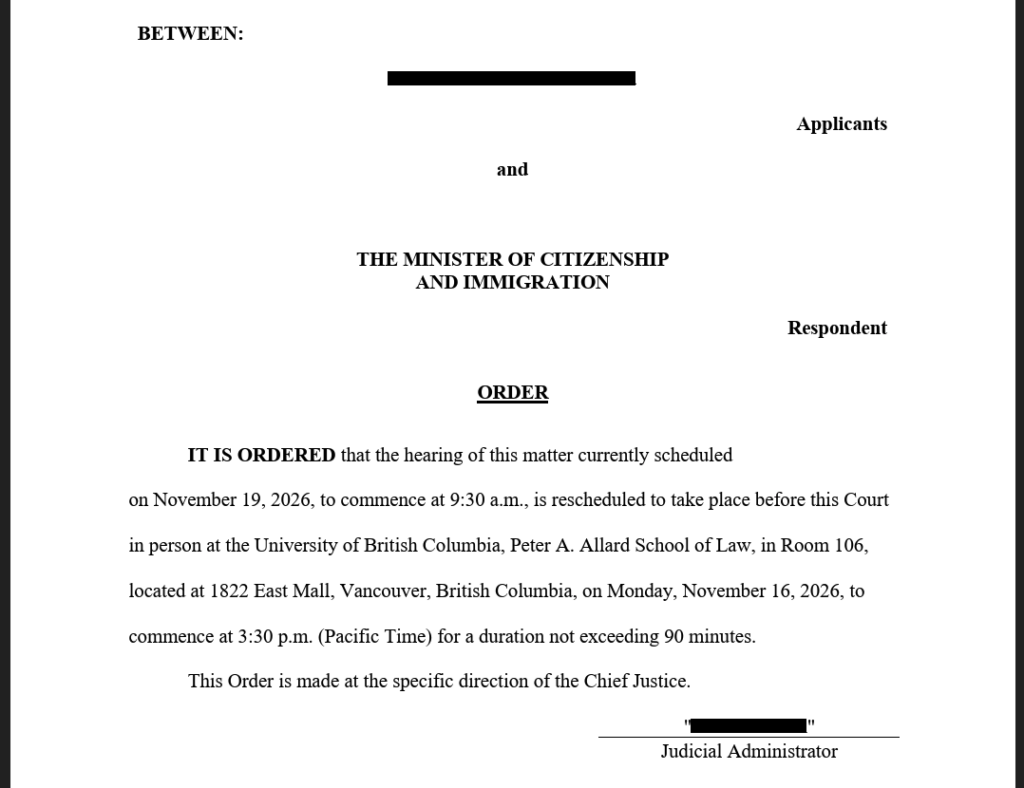
Both redacted orders state that the order was made at the specific direction of the Chief Justice.
The redacted versions are provided for informational purposes only. They should not be interpreted as reproducing or disclosing information that has been redacted from the Court documents.
The Federal Court also advises that its hearings are generally open to the public, subject to applicable exceptions, and publishes hearing information through its official hearing lists and calendar.
Legal disclaimer: This article is intended for general educational and informational purposes. It is not legal advice and does not constitute legal advice concerning any particular case or person. The discussion of judicial review is general in nature and should not be relied upon as a substitute for advice from qualified Canadian legal counsel.