

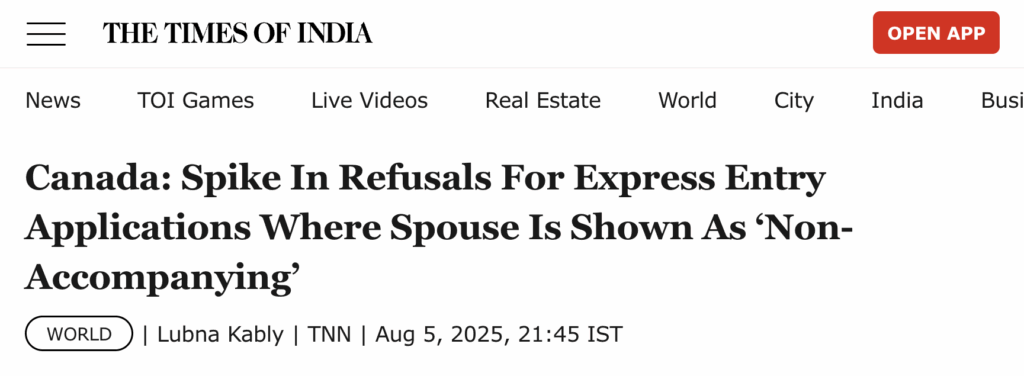
In recent months, Fateh Law Corporation has observed a troubling trend in the decisions issued by Immigration, Refugees and Citizenship Canada (IRCC) — a sudden surge in Express Entry refusals where applicants are being penalized for listing their spouse as non-accompanying, even when that spouse already holds temporary resident status in Canada.
This pattern is not only inconsistent with past practice, but also contradicts the legal principles set out in Canada’s Immigration and Refugee Protection Act (IRPA), particularly Section 22(2) — the “dual intent” provision. The issue has far-reaching consequences for families, policy consistency, and access to justice.
1. The Legal and Policy Context
1.1 What Is an Express Entry Application?
Express Entry is Canada’s flagship immigration system, designed to select skilled workers for permanent residence based on their qualifications, experience, and adaptability. Applicants often include their spouses and dependents, but the law allows them to mark a spouse as non-accompanying if the spouse intends to join them later.
1.2 The Concept of a Non-Accompanying Spouse
A “non-accompanying spouse” simply means the principal applicant chooses to apply for permanent residency alone, while their spouse remains abroad or on a different status (often a study or work permit). This option has always been lawful and common in Canadian immigration practice.
1.3 IRCC’s Changing Approach
Historically, IRCC did not refuse Express Entry applications on the grounds that the spouse was already in Canada with a temporary status. However, the recent refusals suggest a shift in administrative interpretation, where officers allege misrepresentation or non-disclosure under Sections 16 and 41 of IRPA, effectively punishing applicants for facts that are both truthful and legally permissible.
2. The Legal Contradiction: Dual Intent and IRPA Section 22(2)
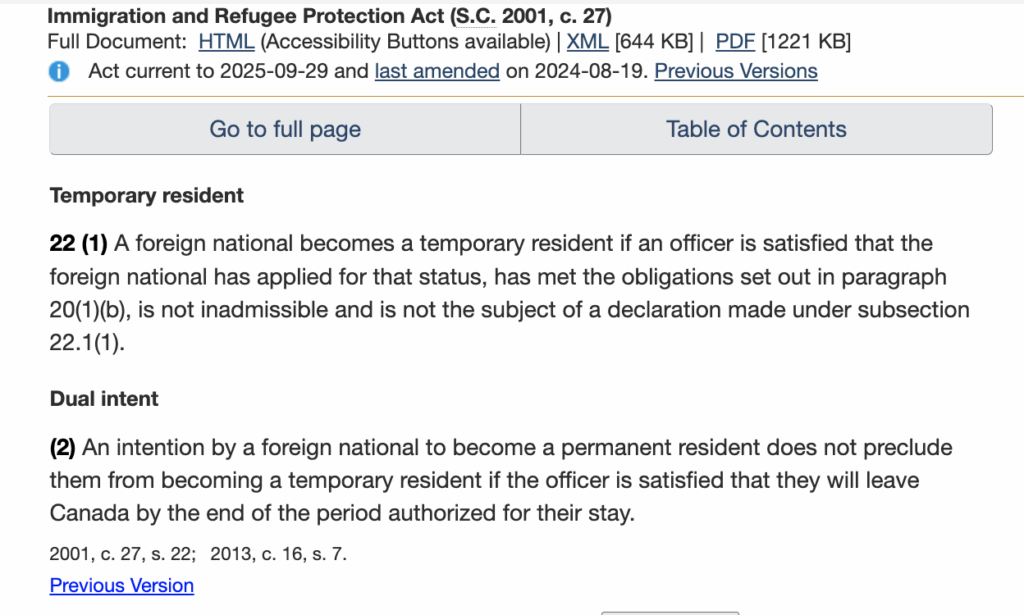
The dual intent provision under Section 22(2) of the Immigration and Refugee Protection Act states that a foreign national can have the intention to reside temporarily in Canada and intend to become a permanent resident in the future — both intentions are lawful and can coexist.
By refusing applications where a spouse is already in Canada, IRCC is violating the spirit of this section. Dual intent was specifically codified to prevent such contradictions — recognizing that individuals may pursue temporary residence (study, work, or visit) while simultaneously pursuing permanent residency through Express Entry.
This shift, therefore, raises a key question:
Is IRCC undermining its own statute by disregarding dual intent when it comes to non-accompanying spouses?
3. The Flawed Backward-Looking Analysis
3.1 The Need for Forward-Looking Decision Making
Immigration law, by its nature, must be forward-looking — focusing on future integration, settlement potential, and genuine intent to comply with Canadian law. However, IRCC officers are increasingly applying a backward-looking analysis, examining past temporary status or past non-accompanying declarations to infer dishonesty.
3.2 Genuine Reasons Must Be Respected
There are countless legitimate reasons why a spouse may not accompany the principal applicant at the time of applying:
- The spouse is finishing studies or work in Canada.
- The spouse is caring for family or children in the home country.
- The family wishes to manage finances before relocating fully.
Each of these reasons reflects responsible planning, not deception. Treating such circumstances as misrepresentation is both unreasonable and unjustified.
4. Misuse of Sections 41 and 16 of IRPA
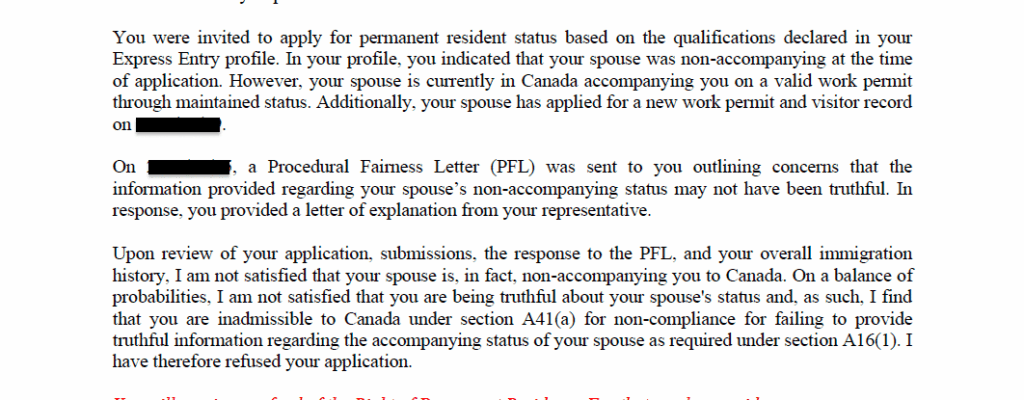 IRCC is increasingly invoking:
- Section 41 (inadmissibility for non-compliance), and
- Section 16 (duty to answer truthfully and provide relevant information),
to justify refusals — arguing that the applicant failed to “truthfully” disclose their spouse’s intent. In reality, these sections were never meant to apply to such situations.
If the spouse’s temporary presence in Canada has already been declared, and the non-accompanying choice is made for legitimate reasons, there is no deception. Instead, IRCC’s use of these sections appears to be a policy-driven effort to reduce the number of permanent residency approvals under political or administrative pressure.
5. The Broader Implications
5.1 Uncertainty and Inconsistent Decision-Making
When IRCC officers apply varying interpretations of the same law, applicants lose confidence in the system. The rule of law demands predictability and fairness, not shifting interpretations based on bureaucratic targets.
5.2 Political and Policy Pressures
Canada’s immigration system is facing record application volumes. In times of high political pressure to control immigration levels, officers may be encouraged to adopt restrictive readings of the law. Unfortunately, such decisions disproportionately affect genuine applicants — families who are following the rules.
5.3 The Human Cost
Behind every refusal lies a story of family separation, financial loss, and emotional distress. Many spouses and children are already lawfully in Canada, contributing to society, yet find their hopes for stability crushed by decisions that contradict both the spirit and letter of Canadian immigration law.
6. The Role of the Federal Court of Canada
6.1 Challenging Wrongful Refusals
Applicants have 15 days (if they are in Canada) or 60 days (if they are outside Canada) to challenge an IRCC refusal through a Judicial Review in the Federal Court of Canada. This is not merely an appeal — it’s a constitutional safeguard ensuring that administrative discretion is exercised lawfully.
6.2 Why Judicial Review Matters
Federal Court intervention brings:
- Consistency in the interpretation of law.
- Accountability for administrative overreach.
- Certainty for applicants and legal representatives.
When the Federal Court clarifies how “dual intent” and “non-accompanying spouse” should be interpreted, it sets a precedent that binds future decisions — preventing arbitrary refusals.
7. Fateh Law Corporation’s Legal Position
At Fateh Law Corporation, we firmly believe:
- Dual intent under Section 22(2) must be respected and enforced.
- IRCC must conduct a forward-looking assessment, not penalize based on assumptions.
- The use of Sections 41 and 16 in these cases is legally unsound.
- Applicants deserve judicial clarity and fairness, not inconsistency.
Our firm has represented numerous clients facing similar refusals and has successfully challenged IRCC’s flawed interpretations in the Federal Court of Canada. In many cases, the Court’s intervention has led to reconsideration and approval.
8. Taking Action: What You Can Do
If your Express Entry application has been refused due to a non-accompanying spouse who is already in Canada:
- Act quickly. You have 15 days (inside Canada) to file for judicial review.
- Gather your evidence. Show that your spouse’s temporary status and non-accompanying choice were genuine and disclosed.
- Consult a Federal Court lawyer. These cases require precise legal drafting and familiarity with case law.
- Do not reapply blindly. Filing a new application may not fix the underlying issue — a court challenge is often the only way to set the record straight.
9. Conclusion: The Call for Certainty and Fairness
The current wave of refusals highlights a deeper issue — uncertainty in Canadian immigration policy. When administrative interpretations fluctuate without transparency, families suffer, and the credibility of the system erodes.
Canada’s immigration framework was built on integrity, dual intent, and opportunity. It must not be reduced to an inconsistent numbers game. The Federal Court of Canada must intervene to restore clarity and uphold the principle that genuine applicants should not be punished for technicalities or policy shifts.
If you’ve been refused under Sections 41 or 16 of IRPA, or your Express Entry application was declined because your spouse was listed as non-accompanying while already in Canada, do not lose hope.
This may be your golden opportunity to not only secure permanent residency but also to help shape fair immigration law for future applicants.
Contact Fateh Law Corporation
📍 Fateh Law Corporation
Federal Court & Immigration Litigation Specialists
📞 Book Your Consultation Today at www.navratanfateh.com
Fight back. Seek justice. Restore your future.